BETTER TO PROTECT THAN REGRET
CAUSES OF HAIR LOSS
Think Tank
BASIC REASONS OF HAIR LOSS
Many people have misconceptions about the actual causes of hair loss. Some believe that they begin to lose the hair when the blood supply to the head goes down. Others think that using ordinary soaps or shampoos cause hair loss and keep trying the latest brand of shampoo or soap. While some people thought that combing or brushing too frequently harms the hair also some people believed that having your head shaved will stimulate hair growth. Others go for miracle growth formulas or false cures. According to science, the most common cause of hair loss is a hereditary condition that happens with aging. In most cases, an individual’s genetic makeup determines if hair follicles are sensitive to the chemical dihydrotestosterone (DHT), which causes them to shrink. This shrinkage results in overall thinning over time. Though this is the universal change in all of us, several hormonal, genetic, or disease states make some of us lose hair earlier in life and larger, more conspicuous quantities. The following is a general discussion on the various known causes of hair loss in both men and women.
Cause One
ANDROGENETIC ALOPECIA
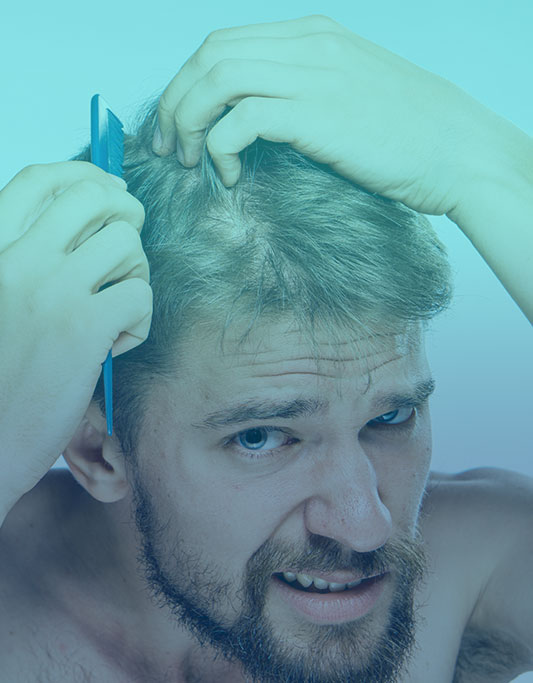
One of the most common types of hair loss in both men and women is androgenetic alopecia, or the male-pattern baldness or female-pattern baldness. It is related to hormone levels in the body as well as a genetic tendency to lose hair, which may be inherited. It affects 50 percent of men and as many women over the age of 40. The cause of hair loss is a body chemical called dihydrotestosterone (DHT), synthesized in the body from the male hormones (androgen’s) that all men and women have, by the action of the five-alpha reductase enzyme. People having a lot of this enzyme make more DHT in their body, causing the hair follicles to make thinner and thinner hair until, eventually, they disappear permanently. In men, the loss of hair follows a semicircular pattern around their head, with the hair on the sides and back of the head left untouched. Women’s hair pattern is different; it is a general thinning of women’s hair, with loss predominantly over the top and sides of the head.
Cause Two
ALOPECIA AREATA
Another important cause of hair loss is alopecia areata, an autoimmune disease where the hair follicles are attacked by white blood cells, making the hair follicle small and slowing hair production so dramatically that there may be no visible hair growth for months or years. So, the results in the development of patches of baldness, usually in small circular areas of the scalp. This disease usually affects young adults of both genders. After some time, hair may come back in patchy areas, or not re-grow at all. A severe form of alopecia areata is the total loss of scalp hair (alopecia Totalis), the complete loss of all body hair (alopecia Universalis). About 33% of those afflicted with these rare problems will grow back all their hair within a year. Recurrences may not occur at all.
Cause Three
Telogen Effluvium
Another common form of hair loss is a condition called Telogen effluvium, which is a widely spread out shedding of hair around the scalp and elsewhere on the body. It is usually happening as a reaction to intense stress on the body’s physical or hormonal systems or as a reaction to the medication. The condition can occur at any age. It generally begins suddenly and gets better on its own within six months, but for some people, it can become a chronic problem. Telogen effluvium is a phenomenon related to the growth cycles of hair. Hair growth cycles alternate between a growth phase (called Anagen that lasts about three years) and a resting phase (Telogen that lasts about three months). During Telogen, the hair remains in the follicles is extracted out by the growth of new hair in the Anagen phase. At one time, up to about 15% of hairs are in Telogen. But three months later, a large number of hair follicles shed. However, as the new hairs start to grow out, the density of hair may thicken again.
Cause Four
ANAGEN EFFLUVIUM
Like Telogen effluvium, this form of hair loss initially causes patchy loss of hair, which often then advances to total hair loss. In this form of hair loss, rather than just shutting down the hair follicle, a chemical kills the hair follicle and Anagen hair. The most common example of this is the effects of drugs used to treat cancer. The hair usually grows back within six months of the end of chemotherapy.
Does hair loss get you down?
Talk to our experts. They will guide you until you get satisfied.