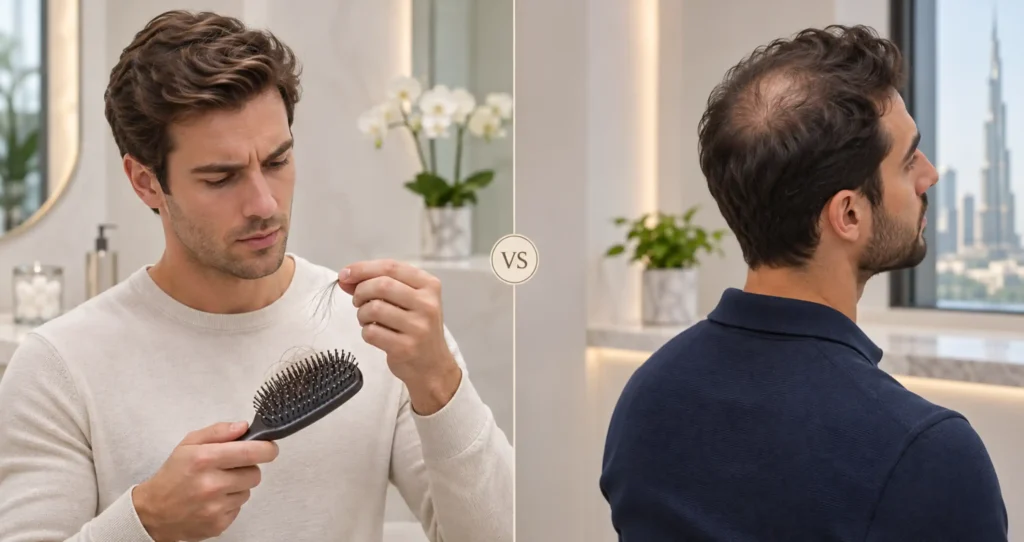
A person comparing hair shedding vs hair loss may be trying to decide whether hairs collected during grooming are a temporary change or evidence of progressively reduced density. The differences are important because the safest next step depends on the cause. The main service and educational entrypoint at Tunio provides clinic context, while this article explains the distinct symptom patterns without prescribing surgery.
Direct Answer: Is Shedding the Same as Hair Loss?
Understanding hair shedding vs hair loss starts with recognising that these terms describe related but different observations. Shedding means hairs are released as part of the normal growth cycle or in greater numbers because something has shifted that cycle. Hair loss is a broader term that includes noticeable reduction in hair density, miniaturisation, patches of missing hair and sometimes breakage or scarring disorders.
Someone can shed many strands during washing without a permanent decrease in density; another person may notice gradual scalp visibility without dramatic daily shedding. The American Academy of Dermatology explains that shedding approximately 50 to 100 hairs a day can be normal, but that number is a population-level illustration, not a diagnosis for an individual. A worsening part, gradually receding hairline or new patch warrants attention to pattern and duration. The distinction helps identify useful next steps, not provide certainty from a hair count alone.
What Happens During the Normal Hair-Growth Cycle?
Scalp follicles do not all grow and rest simultaneously. Many produce hair during the growing phase, anagen, while others transition through catagen and a resting phase known as telogen. Eventually a shaft is released and another growth cycle can begin from a functioning follicle. An important distinction in hair shedding vs hair loss is that normal shedding occurs every day because scalp follicles cycle independently. The amount noticed on any single day can depend on washing frequency, brushing, hair length and whether loose strands have accumulated between washes.
A person who washes once a week may see many hairs in one shower, even when the average daily process is ordinary. This is why a dramatic-looking drain photograph is not equivalent to a clinical measurement of follicle health. The important questions are whether density has changed, whether there are scalp symptoms and whether shedding represents a sustained departure from the person’s usual pattern.
Shedding: A Symptom Rather Than a Diagnosis
When comparing hair shedding vs hair loss, it helps to recognise that people often use the term hair fall for every strand they notice on clothing or in the bathroom. Clinically, a rise in shedding can have several causes, including a temporary shift into the resting phase after a physical stressor. That process is often called telogen effluvium when it meets the clinical picture. Increased shedding can also coexist with hereditary thinning, so one explanation does not necessarily exclude another.
A dermatologist uses the history, examination and sometimes a hair-pull test to interpret what is happening. A long hair with a small pale club-shaped end may be a naturally shed telogen hair, but a home visual inspection cannot reliably classify all conditions. Trying to diagnose from individual fallen strands can create unnecessary worry. Instead, document the approximate onset, duration, recent health events and any changes in visible coverage across the scalp.
For the mechanisms of inherited follicular miniaturisation, Tunio’s published overview of androgenetic alopecia explores a narrower topic than this shedding-versus-loss comparison.
| Key consideration | What the article explains |
| Shedding: A Symptom Rather Than a Diagnosis | In everyday language, people often use hair fall to describe every strand they see on clothing or in the bathroom. |
| How Hereditary Pattern Thinning Can Look Different | Androgenetic alopecia develops when susceptible follicles progressively produce finer hairs. |
| Using Consistent Photographs to Observe Progression | Take photographs of the frontal hairline, temples, top and crown under the same lighting and with hair in a similar dry state. |
Hair Loss: Look for Changes in Coverage and Distribution
When evaluating hair shedding vs hair loss, progressive thinning may become apparent through increased crown visibility, a widening central part, receding temples or reduced overall hair density. Some conditions cause well-defined round patches; others lead to diffuse thinning or inflammation. The American Academy of Dermatology lists a receding hairline, bald patches and overall thinning among possible signs. These patterns matter because different diseases produce different distributions and respond to different treatments. Hair appearance alone is still not enough to establish the cause.
A tight hairstyle, wet hair or strong overhead lighting can make normal coverage look lower. The clinician may compare standardised images and inspect hair-shaft calibre and scalp skin. A persistent pattern deserves evaluation even if little hair appears in the shower, because follicular miniaturisation does not always create an obvious episode of dramatic shedding.
A Useful Comparison: Volume, Density, Breakage and Shedding
In a hair shedding vs hair loss comparison, volume describes how full a hairstyle appears, whereas density relates to the number of hairs in a given scalp area. Shedding describes hairs leaving the scalp; breakage describes a shaft snapping while part of the hair remains. A haircut, humidity or change in conditioning can alter visual volume without changing density. Bleaching and heat styling can increase breakage, making hairs appear short or frizzy rather than creating the same picture as pattern hair loss. If somebody reports hair ‘coming out’, ask whether the strands are full length, whether short broken pieces are present and whether the scalp itself looks different.
These observations are clues, not diagnostic tests. A clinician may need to examine individual shafts or the skin to distinguish them. Accurate language keeps patients from buying a treatment for hereditary loss when the main issue is hair-shaft damage, or ignoring a progressive condition because the shower drain looks normal.
Temporary Shedding After Fever, Illness or Surgery
When considering hair shedding vs hair loss after illness or surgery, telogen effluvium is one possible explanation for increased shedding following fever, major operations or significant physiological stress. The timing is often delayed, so the person may not connect shedding with the earlier event. The American Academy of Dermatology describes how a clinician considers recent childbirth, severe illness and substantial weight change while investigating hair loss. Not everyone exposed to a stressor develops the same response, and multiple causes may coexist.
A patient should describe the event, medication changes, overall recovery and the onset of shedding rather than assume it must be related. When a temporary trigger has resolved, shedding may improve without a transplant or permanent medication, but the likely course should be assessed individually. If scalp pain, bald patches or visible scarring appears, a more specific disorder may need attention. A history of stress is not a reason to dismiss every sign of hair loss without examination.
How Hereditary Pattern Thinning Can Look Different
In the context of hair shedding vs hair loss, androgenetic alopecia differs from temporary shedding because susceptible follicles progressively produce finer hairs. In men, changes may be visible at the temples or crown; in women, a widening part or reduced top-of-scalp fullness is common. The visible change may be gradual over years rather than sudden. Some people with hereditary loss also notice shedding, and stress-related shedding may reveal underlying miniaturisation that had previously been subtle.
Genetics can be inherited through multiple family lines, so the absence of a known bald relative does not rule out the diagnosis. Hormones influence the process, but an unsupervised hormone panel does not replace a scalp assessment. For a deeper explanation of hereditary miniaturisation rather than this comparison of symptoms, the clinic’s published article on androgenetic alopecia addresses the underlying pattern. This guide remains focused on recognising which observations justify the next question.
Hair Loss and Shedding Can Occur Together
The distinction between hair shedding vs hair loss is not always absolute, because a patient may experience both telogen effluvium and female or male pattern hair loss. For example, a temporary burst of shedding after illness can reduce the apparent volume and make a gradually widening part more noticeable. Treating the situation as only temporary or only hereditary may miss part of the picture. The dermatologist may assess variation in hair-shaft thickness, the distribution of thinning, the scalp’s condition and changes over time. Sometimes a short period of monitoring is useful before drawing a confident conclusion.
Treatment decisions can be more complicated when two mechanisms are active, and copying an online routine designed for one diagnosis may be inappropriate. The patient should ask which finding supports each suspected cause and what would change the care plan. A clear explanation may reduce the temptation to switch products repeatedly every time shedding increases slightly.
Readers whose thinning affects a widening part may also consult the site’s women’s hair-loss treatments guide as background before discussing safe individual care.
Sudden Patches, Pain and Inflammation Are Different Warning Signs
Round bald patches, marked redness, burning, scaling, pus-like lesions or areas that look shiny and scarred deserve clinical attention. Conditions such as alopecia areata or inflammatory/scarring disorders are not adequately described by ordinary shedding. Some may benefit from timely treatment to limit permanent damage. A sudden loss of eyebrows or other body hair can also be important. Do not cover up a painful scalp with strong active solutions in the belief that all hair fall is normal or genetic.
Even if hair is shedding rather than breaking, a clinical examination is needed when symptoms are unusual. The American Academy of Dermatology emphasises that diagnosis starts with the history and examination and can include testing when needed. A blog should encourage patients to recognise warning signs without alarming them into believing every flake or shed hair represents irreversible disease.
Does Daily Hair Counting Help?
When assessing hair shedding vs hair loss, counting every fallen strand usually creates more anxiety than reliable diagnostic information. A brush used after several days without grooming may contain more strands than a brush used multiple times daily. Long hair can make a normal number look impressive, while short hairs are easier to overlook. Hair washing frequency also changes the apparent number collected on one day. The often-quoted range of 50 to 100 hairs per day illustrates ordinary shedding, not a fixed threshold that diagnoses illness when crossed once.
More useful signals include the person’s baseline, consistent visible thinning, recent triggers and scalp symptoms. A clinician may choose a standardised assessment when necessary. For most people, a brief symptom timeline and photographs taken under similar conditions are more practical than weighing hair from a drain. Avoid purchasing a product simply because a social-media challenge labels one day’s count excessive.
Using Consistent Photographs to Observe Progression
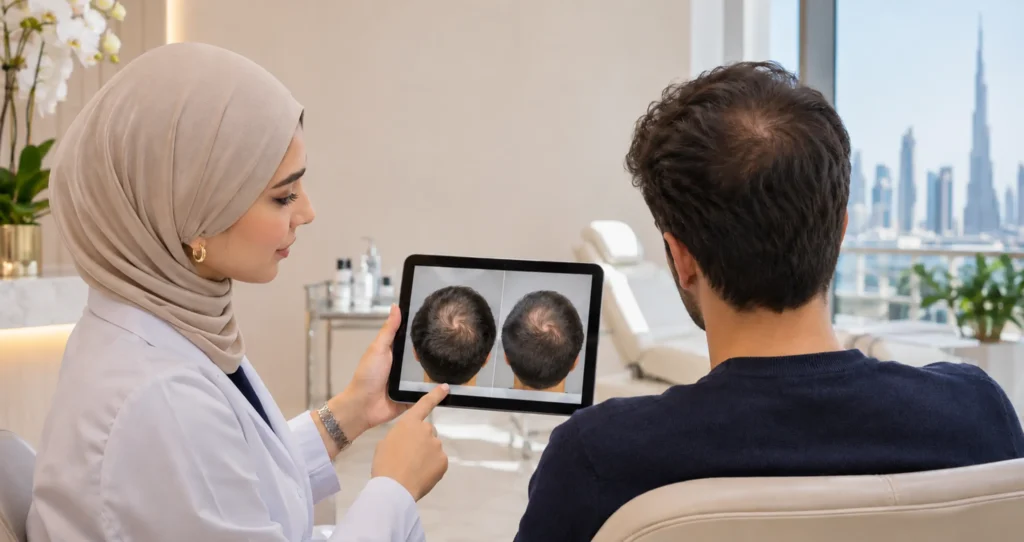
Take photographs of the frontal hairline, temples, top and crown under the same lighting and with hair in a similar dry state. A side-by-side comparison several weeks or months apart may reveal a consistent trend more clearly than daily mirror checks. For people with long hair, the same part position and hairstyle are important. Avoid using thickening fibres or heavy styling products in one image but not the other. A camera’s flash and angle can exaggerate the normal crown whorl; a lower viewpoint can hide it.
Photographs cannot measure microscopic follicle miniaturisation, yet they can help communicate concerns to a clinician. Record the dates along with any illness, new medication or major lifestyle change. The point is to support assessment with comparable evidence, not to turn monitoring into constant inspection of individual follicles or strands.
When to Discuss Blood Tests or Other Investigations
Not every person with hair shedding needs a broad panel of laboratory tests. A clinician may consider testing when the history raises concerns about iron deficiency, thyroid disease, nutritional factors or another health condition. The American Academy of Dermatology also notes that a scalp biopsy may be appropriate in selected situations when the diagnosis remains uncertain. A patient should disclose heavy menstrual bleeding, restrictive eating, major weight change, fatigue, recent pregnancy, new medications and other symptoms relevant to the presentation.
Self-ordering many tests without context can produce confusing results, while taking high-dose supplements without proven deficiency can be harmful. The best approach is to ask what each proposed test is intended to find and whether the result would change management. Investigation should be guided by a medical question, not a universal hair-fall package advertised for every patient.
Hair Care That Helps Without Promising a Cure
Gentle hair care can reduce avoidable shaft breakage and scalp irritation. This may include limiting repeated tight hairstyles, unnecessary heat or harsh chemical processing and selecting cleansing products suited to individual comfort. These practices do not necessarily treat androgenetic alopecia or prevent all forms of telogen effluvium. If itching, scaling or irritation develops, a dermatologist can assess whether a specific scalp disorder needs treatment. Be cautious with home remedies that claim to ‘block DHT’ through an ordinary cosmetic oil or that promise complete reversal of thinning within days.
Cosmetic products can improve manageability and appearance without directly changing follicle biology. A realistic conversation separates improving hair fibre condition from treating the cause of medically diagnosed loss. Simpler routines also make it easier to identify products that trigger irritation or contact dermatitis.
Do Stress and Sleep Explain Every Case?
Psychological stress and disrupted sleep can influence well-being and may contribute to some shedding patterns, but neither provides a complete diagnosis for every person noticing hair changes. An adult may attribute hereditary thinning to work stress and delay assessment, or blame ordinary day-to-day worry for a newly inflamed scalp. Stress-related hair disorders are varied, and their diagnosis depends on the timing, symptoms and examination. Healthy routines are valuable, yet they should not be presented as guaranteed cures for patterned baldness.
If hair changes follow a major illness, surgery or severe life event, tell the clinician about it without assuming causation. For treatment questions, medical history and the pattern of scalp findings remain decisive. Advice should avoid suggesting that a person could have prevented every episode of thinning by being calmer or using a particular supplement.
What Changes During Pregnancy and After Delivery?
Pregnancy and childbirth can alter hair cycling, and postpartum shedding may be noticeable months after delivery. At the same time, some women have underlying female pattern hair loss or a separate scalp condition. The experience therefore cannot be classified solely by the timing of childbirth. A clinician may ask when shedding began, whether the central part has widened, whether the scalp is inflamed and whether other symptoms are present. Pregnancy and breastfeeding also affect treatment suitability, so self-starting prescription medicines or combining several scalp therapies can be unsafe.
This topic deserves its own detailed guide; this article’s role is to show why shedding and lasting density changes should be interpreted separately. Patients should be reassured that not all postpartum shedding requires surgery, while persistent changes or worrying symptoms warrant appropriate evaluation rather than indefinite waiting.
After a diagnosis, this overview of hair-fall treatment choices can help organise questions, although an older promotional article should not replace current evidence or clinical advice.
Should You Consider Medical Hair-Loss Treatment?
Medical options depend on the confirmed diagnosis, relevant contraindications, personal preferences and plans for follow-up. The American Academy of Dermatology explains that therapies such as topical minoxidil can help some forms of hereditary hair loss, but treatment should not be selected merely because shedding is visible. Temporary shedding after a resolved trigger might improve without the same intervention. Prescription medicines may have important safety considerations and are not appropriate for everyone.
A patient can ask what the expected benefit is—slower progression, improved density, or control of inflammation—and when reassessment would be meaningful. Avoid inventing a guaranteed regrowth timeline or promising that a product will stop every hair from shedding. The clinic’s published overview of hair-fall treatment options covers the separate decision of treatment selection after diagnosis; this article focuses on distinguishing the symptom patterns first.
When Hair Transplant Surgery Is Not the Answer
A transplant relocates follicles from a donor region to a recipient region. It does not diagnose the cause of shedding or stop all ongoing loss in native hairs. A person with sudden diffuse shedding, active inflammatory disease or inadequate donor supply may need assessment or treatment instead of surgery. Even when hereditary loss is confirmed, donor preservation and future progression should influence any surgical plan. It is inappropriate to convert the observation of a fuller brush into an automatic recommendation for grafts.
A qualified specialist can explain whether surgery, medical management, observation or further investigation makes sense. This distinction is important for patients researching clinic services in Dubai because commercial pages may emphasise procedures while the medical question remains unresolved. Informed consent begins with diagnosis and realistic alternatives, not an advertised package.
Dubai Weather, Water and Everyday Appearance
Humidity, heat, air conditioning, swimming and frequent washing can change how hair feels and how much scalp is visible during styling. They can also influence hair-shaft dryness or breakage in some people. None of these factors should automatically be declared the cause of progressive follicular miniaturisation. Hair that is wet or clumped after a shower often exposes more scalp than the same hair when dry.
A person commuting outdoors in Dubai may change washing routines and subsequently notice more strands on one day. That observation alone does not establish a new disease. Consider the timing and distribution of changes and explain the full routine to a clinician. Severe scalp irritation, patchy loss or ongoing reduction in density still needs medical assessment. General environmental advice should be cautious rather than claiming a specific local water source causes every case of hair loss.
For people who later explore procedural treatment after diagnosis, these questions about hair transplantation cover a distinct stage of decision-making.
Questions to Ask a Dermatologist or Hair Specialist
A useful appointment starts with a timeline: when did the change begin, what area is involved, and is there sudden shedding or gradual loss of coverage? Bring any comparable photographs and a list of medications, medical events and hair products. Ask whether the appearance is consistent with telogen effluvium, pattern hair loss, breakage or another condition. If a test is recommended, ask why it is relevant.
If a treatment is suggested, discuss the expected outcome, duration, side effects and what would prompt a change in plan. A good clinician should acknowledge uncertainty when findings are not conclusive. Patients should not feel forced to commit to surgery or several medicines before understanding the diagnosis. The aim is a clear next step with realistic expectations, even when that step is monitoring rather than intervention.
Frequently Asked Questions
How much shedding is normal?
The AAD describes approximately 50 to 100 hairs a day as a common range, but individual patterns and washing habits vary.
Can I shed hair without going bald?
Yes, normal cycling releases hairs even when density is maintained.
Can hereditary thinning happen without heavy shedding?
Yes. Progressive miniaturisation may be more noticeable as reduced coverage than as daily fallen strands.
Does stress cause every hair-loss condition?
No. Timing and diagnosis matter.
Does a visible crown mean permanent loss?
Not necessarily; lighting, hair whorls and other causes can change appearance.
Are broken hairs the same as shed hairs?
No. Breakage affects the shaft; shedding means a hair has been released.
Should I order blood tests myself?
Discuss clinical indications with a healthcare professional.
When should I seek help?
If the change persists, progresses rapidly, forms a patch or comes with pain, inflammation or other significant symptoms.
Final Perspective: Notice the Pattern, Not Just the Strands
The central distinction in hair shedding vs hair loss is that shedding describes hairs leaving the scalp, while hair loss can involve lasting changes in density, distribution or follicle behaviour. Normal cycling produces some shedding every day, and a temporary shift can increase that amount without necessarily causing permanent baldness. Gradual changes in hairline or part width can indicate a different process even when shower shedding seems ordinary.
Clinical evaluation is especially helpful when the timeline is unclear, conditions may overlap or unusual scalp symptoms occur. Use a small set of consistent photographs and a brief medical history rather than a daily hair-count competition. Avoid guaranteed cures and surgery recommendations before diagnosis. The next sensible step is to understand the cause and choose a proportionate plan with a qualified clinician.
SOURCE NOTES — VERIFY BEFORE PUBLICATION
American Academy of Dermatology — Hair loss overview
American Academy of Dermatology — Signs and symptoms
American Academy of Dermatology — Diagnosis and treatment
The external resources support general educational statements; they do not endorse the clinic or an individual treatment. Recheck each link at the final editorial review.
Keep reading