

Quick answer: A hair transplant consultation in Dubai should confirm the hair-loss diagnosis, evaluate donor stability and explain whether surgery is suitable before discussing a graft package. Ask who performs each surgical stage, how the design accounts for future loss, what scarring and complications may occur, and what is included in the written treatment and follow-up plan. Verify the operating professional and facility through the appropriate local regulator. A good consultation may recommend medical management, monitoring or no operation rather than an immediate booking.
What a proper consultation should establish
For patients arranging a hair transplant consultation in Dubai, the priority is a careful diagnosis, a realistic assessment of donor supply and an explanation of alternatives. The clinic’s existing guide to choosing a hair transplant clinic addresses the broader research process; use this article to organise the clinical questions for your own appointment.
A hair transplant consultation in Dubai should help determine the cause of hair loss, whether surgery is appropriate, and what a realistic longer-term plan might look like. It should not begin with a guaranteed graft count or a promise of permanent density. A specialist usually reviews medical history, hair-loss pattern, donor availability, medications, expectations and future progression before recommending an approach.
Understanding the diagnosis before discussing surgery
During a hair transplant consultation in Dubai, it is important to establish that not every form of hair loss is suitable for transplantation. Active inflammatory scalp diseases, diffuse thinning, scarring conditions and some temporary shedding patterns may require investigation or stabilisation first. A clinical evaluation may include scalp examination, standardised photography, dermoscopy or other investigations when appropriate. Clarifying the diagnosis helps avoid surgery that cannot address the underlying problem.
Evaluating the donor area and future planning
A hair transplant consultation in Dubai should establish that donor hair is a finite resource requiring careful long-term planning. An assessment should discuss the density and quality of available donor hairs, the likely rate of future loss and how many grafts can be harvested safely. The plan should account for potential progression in untreated hair and the possibility of needing further care. An overly aggressive hairline design may not age naturally or may use too much donor supply.
Questions about the surgical team
It can be helpful to bring a written list of questions rather than relying on memory in the appointment. Tunio’s guide to questions for a hair-loss specialist provides another starting point, including diagnosis and treatment-choice discussions. Ask specifically which licensed professional handles each surgical stage.
During your hair transplant consultation in Dubai, ask who will perform the key stages of surgery, what qualifications and licensing they hold, and how complications are handled. Clarify whether a clinician or technician performs harvesting, incision creation and implantation. Confirm the venue and after-hours emergency contact arrangements. Transparent roles matter more than marketing labels such as ‘best’ or ‘guaranteed’.
Comparing treatment options without rushing
For basic definitions and common misconceptions, readers can consult the site’s answers to frequently asked hair-transplant questions before comparing techniques. An online FAQ cannot establish your candidacy, graft requirements, complication risk or likely result, so ask the clinical team to address your particular circumstances.
A hair transplant consultation in Dubai may cover medical hair-loss management, non-surgical measures and different surgical techniques. Appropriate options depend on diagnosis, preferences, donor supply and risk tolerance. Ask about possible scarring, recovery, expected shedding, realistic growth timelines and what happens if the result is less dense than hoped. Before-and-after images should be representative, appropriately consented and presented without misleading lighting.
Costs, written estimates and patient logistics
During your hair transplant consultation in Dubai, request a written estimate covering surgeon involvement, procedure components, medication, postoperative visits and potential revisions. Understand cancellation policies, likely downtime and follow-up arrangements. If travelling to Dubai, plan enough time for assessment and initial care; tourism schedules should not determine whether a procedure is medically appropriate.
Preparing for your appointment
People planning surgery often also want to know what needs discussing before the operation. Tunio’s published dos and don’ts before hair transplant guide introduces that separate preoperative topic. Confirm every medication, supplement and lifestyle instruction with the treating surgeon; do not stop prescribed treatment because of a general blog.
Before your hair transplant consultation in Dubai, prepare a list of current medicines and supplements, relevant health information, and photographs showing how your hair has changed. Write down your goals: maintaining a natural-looking hairline, addressing crown thinning, or understanding non-surgical options. Be prepared to discuss smoking, prior surgeries and any history of unusual scarring or problems with healing. Do not stop prescribed medication without guidance.
Direct Answer: What Happens at a Consultation?
A hair transplant consultation in Dubai should be an assessment, not a sales appointment disguised as medical advice. The clinician should investigate the reason for hair loss, review scalp and donor hair, discuss whether treatment is appropriate and explain what surgery can realistically achieve. You should learn who would perform the operation, what technique might be recommended, what complications could occur and what support is available afterward.
A responsible consultation can end with a recommendation for monitoring or medical treatment instead of surgery. Price, package size and a promised graft number should follow the examination rather than determine it. Take time to ask questions and consider the explanation. A transplant redistributes a limited supply of follicles; it does not prevent future thinning of surrounding untreated hair. That long-term limitation is fundamental to a sound plan.
The First Decision: Is the Diagnosis Correct?
The location of thinning alone does not prove that the patient has androgenetic alopecia. A receding temple, widening part or thinning crown may fit a hereditary pattern, but diffuse shedding, inflammatory conditions, scarring alopecias and other causes require different approaches. A clinician will usually discuss the timeline, family history, recent illness, medications, scalp symptoms and previous treatments. Where indicated, closer scalp examination, trichoscopy or relevant tests may help establish the diagnosis.
Surgery on an unstable or incorrectly diagnosed condition can give disappointing results and may expose the person to unnecessary risk. Ask what evidence supports the diagnosis and whether it could change over time. Sudden shedding, patchy loss, pain or scaling deserves particular attention. A good consultation allows the clinician to explain uncertainty rather than forcing every person into the same surgical pathway.
Medical History That Should Be Discussed
A hair transplant consultation in Dubai should consider your overall health and medical history, not just scalp photographs. Inform the clinician about prescription and nonprescription medicines, allergies, bleeding concerns, previous anaesthetic reactions, smoking or nicotine use, chronic illnesses and prior operations. Some supplements and medications can affect bleeding or wound healing, but changes must be managed by an appropriate healthcare professional; never stop a prescription on the basis of a generic online checklist.
Mention prior treatments for hair loss and whether they caused irritation or adverse effects. If there is a history of unusual scarring, slow healing or scalp infection, ask how that changes candidacy. The surgeon may coordinate with another specialist or request further information. The purpose is to individualise risk rather than to create paperwork. Patients should receive a clear explanation of any findings that make treatment safer to defer.
Why Age and Future Hair Loss Progression Matter
During a hair transplant consultation in Dubai, patients should understand that hair-loss patterns can continue changing after surgery. Someone in early adulthood may have a hairline that is still receding, while a person later in life may show a more established distribution. Age alone does not determine suitability, but the likely future course should influence hairline design and how donor follicles are allocated. Ask what will happen if native hair behind the transplanted region continues to thin.
A low, dense hairline may look appealing in an immediate illustration but become difficult to maintain if further loss leaves isolated transplanted hairs. A conservative plan is not necessarily an inferior result; it can preserve options for later care. The consultation should discuss ongoing monitoring and evidence-based nonsurgical management where appropriate, including benefits and potential adverse effects. A clinician cannot accurately predict every patient’s future loss, and honest uncertainty is preferable to a promise of permanent, unchanged density.
Assessing the Donor Area as a Limited Resource
During a hair transplant consultation in Dubai, the surgeon should examine the back and sides of the scalp, where follicles are commonly harvested. The relevant questions are not only how many grafts might be obtained but also what effect harvesting could have on the donor area’s visible density. Hair calibre, colour contrast, coverage, donor stability and pre-existing scars can change planning substantially. Dense extraction from a limited area may produce noticeable thinning, especially with short hairstyles.
Ask whether the proposed number of grafts fits both current needs and possible future sessions. The clinician should explain the difference between available graft estimates and a confirmed safe harvest plan. Donor follicles cannot be replaced automatically once moved. A serious consultation treats donor conservation as an important long-term responsibility rather than an obstacle to hitting an advertised graft count.
Designing a Hairline That Can Age Naturally
Hairline planning during a hair transplant consultation in Dubai involves more than tracing the lowest point where hair once grew. The clinician must consider facial proportions, existing temple shape, age, hair characteristics, available donor supply and likely future progression. A design that looks striking in a quick digital mock-up may not be appropriate for everyone. Ask whether the first row of the hairline is planned to look naturally irregular and whether hair direction and density will be considered.
Expectations should be communicated clearly: some patients want subtle restoration, while others prioritise crown coverage or overall visual balance. The plan must respect the limits of donor supply rather than promise identical density in every region. Photographs of representative results can be informative when lighting and styling are comparable, but no photograph establishes that an individual will achieve exactly the same outcome.
What FUE and FUSS Mean for Your Decision
Two common surgical approaches are follicular unit extraction, often called FUE, and strip harvesting, sometimes described as FUSS or FUT. The methods differ in how follicles are obtained and in the character of the donor-area scars. FUE uses many small extraction sites; strip harvesting removes a narrow strip of scalp and creates a linear donor closure. Both require careful planning and can leave scars.
The consultation should explain why one option is considered appropriate in the patient’s particular situation, including donor characteristics, planned graft number, preferred hairstyle and previous procedures. Avoid assuming that an advertised technique is automatically scar-free, painless or always superior. The NHS notes that hair transplantation is a surgical procedure with potential bleeding, infection, scarring and graft-related complications. A responsible recommendation compares relevant trade-offs without presenting the operation as risk-free.
Who Performs Each Step of the Operation?
Patients have a right to understand the roles of the people who will operate on them. Ask who will assess the hair loss, design the hairline, administer anaesthesia, perform harvesting, create recipient-site incisions and place grafts. Find out each person’s qualifications, experience and legal scope of practice. The International Society of Hair Restoration Surgery urges patients to ask specifically who is performing surgical steps and whether anyone involved is appropriately licensed.
This is particularly important when marketing uses a famous doctor’s name but does not clarify who will actually be present. Do not assume that a large team means the lead surgeon directly performs every stage, or that a surgeon’s photograph proves involvement. Request transparent written confirmation of responsibilities. If the answers are vague, inconsistent or evasive, reconsider the booking rather than accepting reassurance without detail.
Checking Clinic and Professional Licensing in Dubai
Verifying professional and facility licensing during a hair transplant consultation in Dubai is a practical safety check, not a formality. The Dubai Health Authority’s Sheryan system and Dubai Medical Registry provide routes for checking registered healthcare professionals and facilities within the authority’s jurisdiction. Patients should confirm the relevant regulator for the facility in which treatment will occur, because administrative arrangements can vary. Ask for the operating location, clinician’s full professional name, registration details and the facility’s licensing information.
Do not treat social-media popularity, search advertising or a luxury reception as proof of appropriate clinical privileges. A facility may provide consultations in one location and perform procedures in another; clarify both. The aim is to verify that the actual surgical team and venue are authorised to provide the procedure. When uncertain, use the relevant official regulator rather than a third-party promotional directory.
| Consultation topic | What should be assessed | Question to ask |
| Diagnosis and donor hair | Check the hair-loss cause and stability of donor supply. | Is transplantation appropriate for my condition now? |
| Surgeon and facility | Clarify who performs each stage and which site is used. | Who performs surgery and how can credentials be verified? |
| Aftercare and price | Discuss follow-up arrangements and a written cost breakdown. | What is included in the estimate and complication care? |
What a Meaningful Graft Estimate Should Include
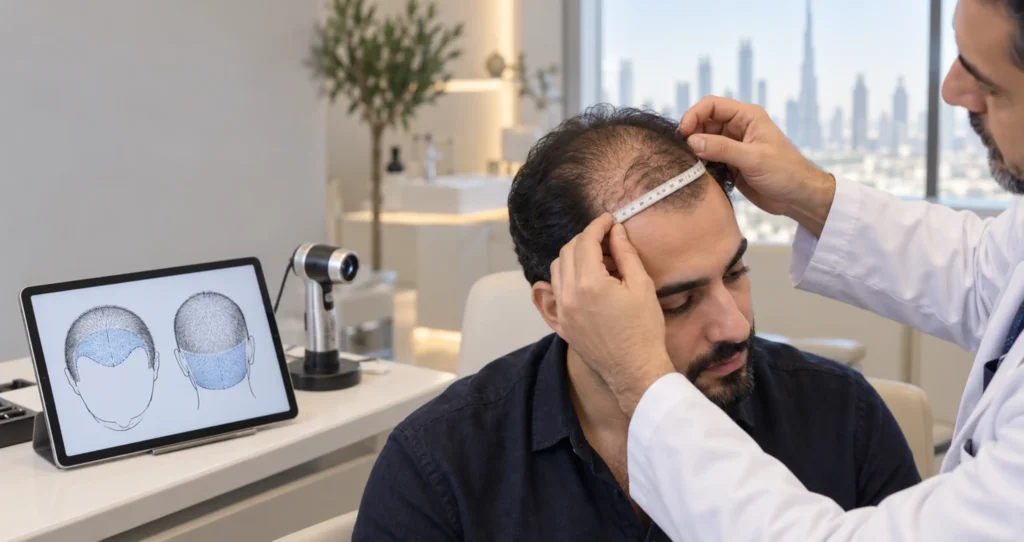
Graft counts are often emphasised in advertisements, yet they are only one part of treatment planning. The same number of follicular units can create different visual coverage depending on hair thickness, curl, colour, scalp contrast and distribution. An estimate should be tied to the area being treated, the intended density and the available donor hair. Ask whether the proposed count is preliminary or confirmed by examination. Also ask whether harvesting it would compromise donor appearance or future options.
Be cautious if a clinic offers the same package count before examining patients with very different patterns. More grafts are not always better; excessive harvesting or aggressive density can create avoidable problems. A written plan should make it clear what the surgeon is trying to achieve and what may remain untreated. Informed consent is improved by discussing both the potential benefit and its limits.
Treatment Suitability and Nonsurgical Alternatives
A consultation should not automatically lead to a surgery date. Depending on diagnosis and medical history, a specialist may discuss monitoring, medical treatment or other approaches before transplantation. Some medicines used in hair-loss management require ongoing use and assessment for adverse effects. Others may be unsuitable because of age, pregnancy-related considerations, health conditions or personal priorities. Decisions should not be based on a product advertisement or an unreviewed online routine.
Ask how nonsurgical options could fit the plan and whether stabilising further loss would make surgical planning more predictable. If surgery is postponed, request a clear follow-up plan rather than assuming no care is possible. A conscientious clinician should explain why alternatives have been considered and why a particular option may or may not fit your case. The goal is an informed choice, not an immediate transaction.
Realistic Recovery Expectations
Recovery expectations should be discussed during a hair transplant consultation in Dubai before paying a deposit or booking travel. Depending on the technique and individual response, patients may experience scalp tenderness, swelling, crusting, temporary shedding or visible changes in the donor and recipient areas. The NHS cautions that transplanted grafts need particular protection during the earliest recovery period and that visible growth evolves over months. Those general timelines are not guarantees for every patient.
Ask when washing can resume, what headwear is suitable, when work and exercise are possible and what symptoms require contact. The operation’s recipient and donor areas may have different care instructions. A short recovery advertisement does not replace an individual discharge plan. If work involves helmets, outdoor heat, physical activity or public-facing duties, mention these needs during consultation so the clinic can discuss realistic scheduling.
Risks, Complications and What Happens if Results Disappoint
All surgery carries risk. For hair transplantation, potential problems can include bleeding, infection, reactions to anaesthesia, scarring, discomfort and poor graft survival. A patient may also be dissatisfied with hairline design, visible donor changes or the density achieved. The operating surgeon should discuss the likelihood and management of relevant complications in terms the patient can understand. Ask who provides urgent assessment after hours and whether in-person follow-up will be available.
If results fall short of expectations, clarify how they will be evaluated and whether any corrective procedure would have a separate cost. Do not accept a ‘guaranteed result’ as a substitute for proper consent. Even when the procedure is technically well performed, future native hair loss can alter the appearance. Risks should be presented honestly so that the person understands both immediate and long-term consequences.
Using Before-and-After Photos Responsibly
Before-and-after galleries may help patients understand the style of results a clinic has achieved, but photographs can be misleading. Hair length, lighting direction, use of styling fibres, camera position and scalp visibility can create dramatic differences without a corresponding change in density. Ask whether examples represent similar hair calibre and loss patterns and how much time elapsed between surgery and the after photograph. The images should be shared with appropriate patient consent.
Avoid interpreting the most impressive photograph as a guaranteed result for your own scalp. If the clinic offers a visual simulation, ask what assumptions were used and whether the simulation is an illustration rather than a prediction. An honest gallery should show realistic variation, not only a narrow set of exceptional examples. The consultation should return the discussion to your examination and agreed goals.
Understanding a Written Cost Estimate
A hair transplant consultation in Dubai should provide transparent pricing that allows patients to compare options without relying on an artificial one-number clinic ranking. Ask what the written estimate includes: surgeon assessment, anaesthesia, harvesting, placement, medicines, dressings, initial follow-up and any additional appointments. Confirm whether laboratory tests, transport or postoperative products are separate. Clarify cancellation and refund terms before making a payment.
A lower advertised amount does not necessarily mean a less expensive entire course of care, while a premium price does not guarantee superior outcomes. The most useful comparison considers who performs the procedure, what it involves, what happens if complications occur and what follow-up is promised. Keep a copy of the agreed quotation and consent documents. Do not accept pressure to pay immediately because of a short promotional deadline. A medical decision should allow time for independent consideration.
Dubai Travel and Appointment Logistics
People visiting Dubai for surgery should plan beyond the time spent in the operating room. An in-person examination may affect the procedure recommendation, and postoperative care can require follow-up before departure. Discuss the intended travel dates during consultation and ask whether the plan is medically realistic. A long-haul flight or an itinerary involving strenuous tourism might not be appropriate immediately after an operation. Request written instructions, contact details and guidance about where to seek help if a complication occurs after leaving the country.
A remote check-in may be useful for routine photographs or questions, but it may not replace an in-person assessment when there is persistent bleeding, infection concern or severe pain. Hotel arrangements, sun exposure, headwear and work commitments can also affect comfort. Travel plans should follow the care plan, not determine it.
Questions for an International or Out-of-Town Patient
If you live outside Dubai, ask who is responsible for care after you return home and what documentation will be provided. Will you receive an operative summary, treatment details, medicines list and clear instructions for contacting the surgeon? If you develop swelling, fever or unexpected pain, should you contact the clinic, see a local physician or seek emergency care? How are routine progress photographs reviewed, and what symptoms make a video call inadequate?
What is the process if a further procedure is considered months later? These questions are particularly relevant when advertising emphasises all-inclusive travel packages. Patient safety is not automatically included merely because accommodation or transport has been arranged. Confirm whether the clinic’s aftercare arrangements are practical for your home location, and be prepared to adjust travel if the treating clinician considers that necessary.
How to Compare Clinics Without Claiming a Universal Best
There is no universally best surgeon or clinic for every patient. A responsible comparison focuses on licensure, relevant experience, clear surgical roles, a careful diagnosis, appropriate facilities and realistic aftercare. Patients should evaluate the quality of explanation rather than simply the number of social-media followers or a collection of awards. Ask whether the surgeon has experience with your particular loss pattern, donor limitations or previous procedures. A consultation in which your questions are welcomed may be more useful than one dominated by urgency or guarantees.
Compare written plans rather than just package prices. If two surgeons recommend very different graft counts or hairlines, request the reasoning and consider an independent opinion. The aim is not to eliminate every uncertainty but to make the eventual decision transparent, proportionate and consistent with your priorities.
Red Flags During a Sales-Led Consultation
Warning signs can include a guaranteed permanent result, a package selected without scalp examination, pressure to pay before discussing risks, vague answers about who performs surgery or refusal to identify the actual operating facility. Be cautious when a clinic presents transplantation as appropriate for every cause of hair loss or claims that one technique cannot scar. Another warning sign is the absence of a realistic plan for future native hair loss.
The International Society of Hair Restoration Surgery encourages patients to confirm the training, licensing and roles of everyone involved. A credible consultation also explains alternatives, costs and what would happen if the result is disappointing. If a representative discourages questions about complications, ask to speak directly with the clinician who would perform the procedure. A patient should leave with information and choices, not a sense that an irreversible decision must be made immediately.
Planning Questions to Bring to the Appointment
Write down your top concerns before attending. Ask: What is causing my hair loss? Is the condition stable? Am I a suitable candidate? How much donor hair can be removed safely? What hairline would be realistic for my age and possible future loss? Who performs each surgical stage? What scarring should I expect? What are the risks? What follow-up care is included?
What happens if I have a complication? Would medical treatment or observation be appropriate first? Ask which answers rely on direct examination and which are still provisional. Request written information that you can review at home. If the explanation is unclear, ask the clinician to explain it again in plain language. A good consultation should improve your understanding even if you ultimately decide not to have surgery.
Final Decision: Informed Consent Before Commitment
The decision to undergo transplantation should follow diagnosis, discussion of alternatives, realistic expectations and a clear description of the surgical team. Review the consent documents and ask about any points that remain uncertain. Confirm the facility, procedure type, estimated graft requirement, costs, postoperative appointments and how complications are handled.
Understand that cosmetic preferences may change and native hair loss can continue. A surgeon can aim for a natural, balanced result but cannot promise an identical outcome to a photograph or guarantee that another session will never be needed. If you are not comfortable with the explanation, obtaining another opinion is reasonable. The best outcome of the consultation is an informed plan that protects long-term options and respects your goals—whether that plan involves surgery now, treatment first or no procedure at all.
Hair Transplant Consultation in Dubai: Final Checklist
A hair transplant consultation in Dubai is most valuable when it clarifies diagnosis, donor limitations and the roles of everyone performing surgery. Bring medical history, clear progress photographs and a written list of priorities. Ask the surgeon to explain the procedure, scarring, graft estimate, alternatives, follow-up and what happens if complications arise.
Verify licensing through the appropriate Dubai healthcare authority rather than assuming advertising awards are evidence of medical credentials. Review written costs, avoid guarantees and allow time to decide. The consultation should protect future donor options and support an informed decision even when the appropriate recommendation is to postpone or avoid surgery.
Frequently asked questions
Will I receive a precise graft number on my first visit?
It may be an estimate that needs confirmation after examination and planning.
Should I book a transplant before understanding why I am losing hair?
No. Diagnosis should come first.
Is a consultation the same as an operation booking?
No. You should have space to review alternatives, risks and consent documents.
Can an overseas patient complete all follow-up remotely?
Some follow-up may be remote, but in-person care may be needed if complications occur.
Next step: Discuss your individual concerns with a qualified clinician. For the related service and consultation information, visit https://www.tuniohairtransplant.com/hair-transplant-in-dubai/
Editorial note: Verify against live WordPress archive, unpublished drafts, Google Search Console, and current clinical guidance before publishing. Do not publish the proposed URL until checks are complete.
Clinical and Editorial Reference Notes
NHS — Hair transplant: risks and surgeon choice
ISHRS — Do you know who is operating on you?
Dubai Health Authority — Sheryan licensing and Medical Registry
These resources provide general background for editorial review. They do not certify the safety of an individual procedure or replace instructions from the operating clinician.
Keep reading
