
Why the donor area needs its own recovery plan
The FUE donor area healing timeline refers to how the extraction sites recover after follicular units are removed. For a separate surgical overview—not a substitute for personalised aftercare—read Tunio’s explanation of how FUE hair transplantation works. Your own discharge instructions remain the primary source for wound care.
In follicular unit extraction (FUE), individual follicular units are removed from the donor region, usually on the back or sides of the scalp. Each extraction leaves a small healing site. Unlike the transplanted recipient area, the donor area recovers from follicular unit removal and has its own care instructions. Healing rate varies with extraction density, skin health, existing medical conditions, and aftercare.
First 24 to 72 hours: protect the extraction sites
Preparation and recovery are related but different stages. Tunio’s pre-surgery dos and don’ts article can help patients organise questions before their procedure, but advice about medications or washing should always be checked with the treating surgical team instead of copied from an older general blog post.
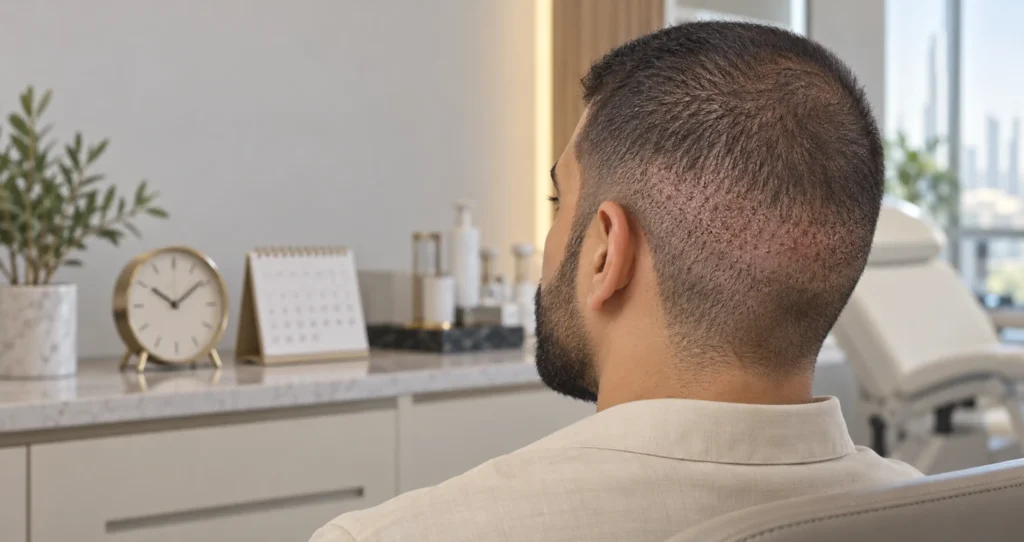
During the first 24 to 72 hours of the FUE donor area healing timeline, tiny punctate wounds, mild redness, tenderness, and occasional spotting may be expected. The surgical team may apply a dressing or recommend a specific cleaning technique. Keep hands away from the healing areas unless following a prescribed care step. Avoid friction from hats, headrests, or vigorous towel drying. Follow your surgeon’s exact advice about washing and sleeping rather than adopting a generic timeline.
Days 4 to 10: scabs and surface healing
For broader background on the FUE procedure and instruments, the site’s earlier FUE hair transplant in Dubai guide explains the sequence around harvesting and placement. This donor-specific article focuses on healing and does not imply that the extraction sites will have identical appearances or recovery speeds in every patient.
During days 4 to 10 of the FUE donor area healing timeline, small crusts generally begin to loosen as the skin heals, although timing differs between patients. Do not pick scabs or scrub the donor region aggressively, because this can irritate tissue and potentially increase complications. Mild itching can occur during healing. The clinic may provide a washing schedule and guidance for gentle rinsing. If redness spreads or discomfort becomes worse instead of better, contact the clinical team.
Weeks 2 to 4: appearance is not the whole story
During weeks 2 to 4 of the FUE donor area healing timeline, the scalp surface may look considerably more settled while deeper tissue continues to remodel. Very short hairstyles can still show extraction dots or temporary unevenness. Temporary shock shedding can sometimes affect nearby hairs. Appearance should not be used as the only sign of recovery; follow restrictions on workouts, sun exposure, and scalp products as directed by the surgeon.
Months 1 to 6: settling and scar maturation
Questions about donor scars, expected outcomes and the role of follow-up can arise long after the initial washing phase. Tunio’s answers to common hair transplant questions provide a more general context; return to your surgeon for personalised evaluation if a new symptom develops or recovery appears unusual.
During months 1 to 6 of the FUE donor area healing timeline, small dot-like scars may remain at extraction sites, even when surrounding hair makes them difficult to see. The visibility varies by skin type, hair density, punch size, and harvesting pattern. Persistent numbness, unusual sensitivity, or dissatisfaction with donor density should be discussed at follow-up. Photographs under consistent lighting can help document how the area changes over time.
Which warning signs require prompt medical contact?
Seek timely medical advice for increasing pain, warmth or swelling, expanding redness, pus-like drainage, persistent bleeding, fever or an unpleasant odour. Contact the surgeon if a new problem appears after an initial period of improvement. Severe or rapidly progressing symptoms warrant urgent medical assessment. Do not begin antibiotics or apply unapproved antiseptics to the scalp without clinical guidance.
Donor-care questions to ask your surgeon
If you are still preparing for surgery, the clinic’s article on nutrition before hair transplantation can serve as an additional discussion prompt. Dietary or medication changes should be approved by your clinician, especially when other medical conditions or prescriptions affect healing.
Ask when to start washing, whether a dressing is needed, when exercise can resume, when clippers or a haircut are suitable, what products to avoid, and what photographs to send during follow-up. Confirm who to contact outside normal clinic hours. Those instructions take priority over any general online donor-area healing timeline.
Direct Answer: What to Expect From the Donor Area
The donor area is the part of the scalp from which follicular units are extracted during FUE. A typical course of recovery begins with small extraction wounds, local redness and tenderness, followed by crust formation and gradual surface healing. Many people see considerable surface improvement over the first couple of weeks, but appearance and sensation can continue to change for longer. There is no reliable promise that every extraction point will disappear or that everyone will be comfortable wearing an extremely short haircut.
FUE usually avoids one long linear donor scar, but it still produces numerous small scars. Most importantly, aftercare must follow the operating surgeon’s instructions for the actual number and distribution of extractions, the patient’s skin and medical history. If pain or redness increases instead of settling, the team should be contacted rather than assuming that every change is normal.
Understanding What Happens Beneath the Short Hair
A follicular unit may contain one or more hairs together with surrounding tissue. During FUE, the surgeon uses a small instrument to isolate individual units and removes them from selected donor locations. The sites are not simply empty pores that immediately return to their previous appearance. Each extraction interrupts the skin and creates a tiny wound that must seal and remodel. Understanding the FUE donor area healing timeline means recognising that the visible surface tends to improve first, while deeper tissue changes and scar maturation take longer.
This explains why redness can fade without the donor area being fully settled. It also explains why postoperative photographs taken a few days apart can look very different even when healing is proceeding appropriately. A wound’s appearance depends on hair length, skin tone, lighting and the way extractions were distributed. Do not infer the number of grafts or the technical quality of surgery from a casual close-up photograph alone.
Why Extraction Distribution Matters to Healing and Appearance
Donor planning is not just about collecting enough grafts for the recipient area. The surgeon must preserve a cosmetically acceptable pattern of remaining hair and avoid concentrating extractions so densely that coverage is noticeably reduced. Patients with finer hair, lower donor density, or a preference for very short haircuts may notice extraction sites more readily. Existing scar tissue, scalp disease, and a history of poor wound healing can further affect suitability. These factors belong in the preoperative discussion and may influence the safest harvesting plan.
Once grafts have been removed, aftercare cannot replace them or reverse overharvesting. A generous amount of moisturiser, a tight cap or an advertised healing serum cannot compensate for inadequate donor planning. If the donor area appears uneven months later, an in-person examination is more useful than trying unverified cosmetic products without understanding the cause.
The First Evening: What to Document and What to Avoid
Before leaving the clinic, patients should know exactly which side of the scalp was harvested, whether a dressing was placed and when it should be removed. They should have a written medication list, a phone number for urgent questions and instructions about washing and sleeping. Mild discomfort or pinpoint crusting may be expected, but persistent bleeding or symptoms that seem disproportionate deserve prompt advice. This is not a time for self-selected antiseptic solutions, scratching or a vigorous shower.
Household towels, helmet straps and hard chair headrests can rub the area unintentionally; simple planning may help avoid friction. If sedation or medicines were used, a safe journey home and any activity restrictions should already have been arranged. Photographs supplied by the clinic may provide a baseline, but the purpose is clinical monitoring rather than comparing each dot or trying to predict final hair density on the first night.
Days Two and Three: Interpreting Tenderness and Redness
In the early days of the FUE donor area healing timeline, surrounding skin may look pink or red, feel tight, or remain sensitive to touch. Small crusts can form as moisture dries around healing openings. Some people describe an itchy or prickly sensation once the initial tenderness begins to subside. These sensations can be compatible with healing, but the direction of change matters. Increasing warmth, expanding redness, worsening swelling, spreading discharge, or a new fever are reasons to contact the surgeon. Patients should not rely on a photograph alone to decide whether inflammation is an infection.
Medicines for pain or infection should be used only according to the written plan. The scalp is also exposed to heat, sun and sweat during everyday life, so patients in Dubai should ask how to avoid unnecessary environmental irritation while continuing basic hygiene. The individual operating team’s advice takes priority over generic day-by-day schedules.
Days Four Through Seven: Washing Without Damaging the Skin
Patients following the FUE donor area healing timeline often want to know exactly when they can wash their scalp normally again. That question has no universal answer, because clinics vary in their dressing practices, procedure details and prescribed cleansing products. A typical written aftercare plan distinguishes gentle wetting or rinsing from vigorous washing. Do not direct a high-pressure shower jet onto the donor area, scrub away crusts or rub the scalp dry unless the operating team has specifically confirmed that the action is appropriate.
Hair products with fragrance, exfoliating ingredients or strong actives may irritate healing skin. Use the product, temperature and technique advised in your discharge instructions. Patients should also check whether the guidance for the donor area differs from the recipient area; the latter contains newly placed grafts and may require particular protection. A comfortable-looking surface does not authorise aggressive cleaning.
The Second Week: Why Surface Healing Is Not the Finish Line
By the second week of the FUE donor area healing timeline, many extraction sites may become less noticeable beneath growing hair. The scalp may feel more comfortable, and the temptation to restart normal styling or workouts can increase. Still, some redness, itchiness, tightness, or variation in sensation may remain. A person with fair or reactive skin may notice colour changes for longer than someone whose skin settles quickly. A patient who keeps the sides of the head shaved closely may see dot-like marks that are hidden when the hair is longer.
Surgeons may reassess washing, sun exposure, haircuts, exercise and headwear at a follow-up appointment. The second week is also a suitable time to raise questions about persistent numbness or focal tenderness. Symptoms that worsen after improving should not be automatically labelled as normal recovery. Careful follow-up is more useful than comparing a personal timeline with an advertisement promising a fixed seven-day recovery.
Weeks Three and Four: Returning to an Everyday Routine
By the end of the first month in the FUE donor area healing timeline, many patients focus more on work, exercise, and their hairstyle than on individual extraction points. This does not mean every activity is automatically safe. The extent of harvesting, whether recipient grafts are still recovering, and any other medical procedures can influence restrictions. Some people may be cleared for normal daily routines earlier, while strenuous exercise or swimming requires an individual decision. Ask whether helmets, tight headwear, intense sun exposure, or close hair clipping might irritate the area.
The safest answer is specific: what activity is planned, how much pressure or friction it creates, and whether the skin is intact. If the area remains inflamed, unusually sore or sensitive, discuss this with the clinic instead of concealing symptoms under cosmetic products. Keeping a short record of ongoing symptoms makes follow-up more productive.
| Recovery stage | Common appearance or change | Practical next step |
| First 72 hours | Small donor extraction sites may be tender or red. | Follow written wound and dressing instructions. |
| Days 4–10 | Surface crusts may begin loosening; timing varies. | Do not pick scabs or wash aggressively. |
| Weeks 2–4 and beyond | The surface can look settled while tiny extraction marks persist. | Discuss haircuts, exercise and follow-up with your surgeon. |
Haircuts, Shaving and the Meaning of Visible Dots
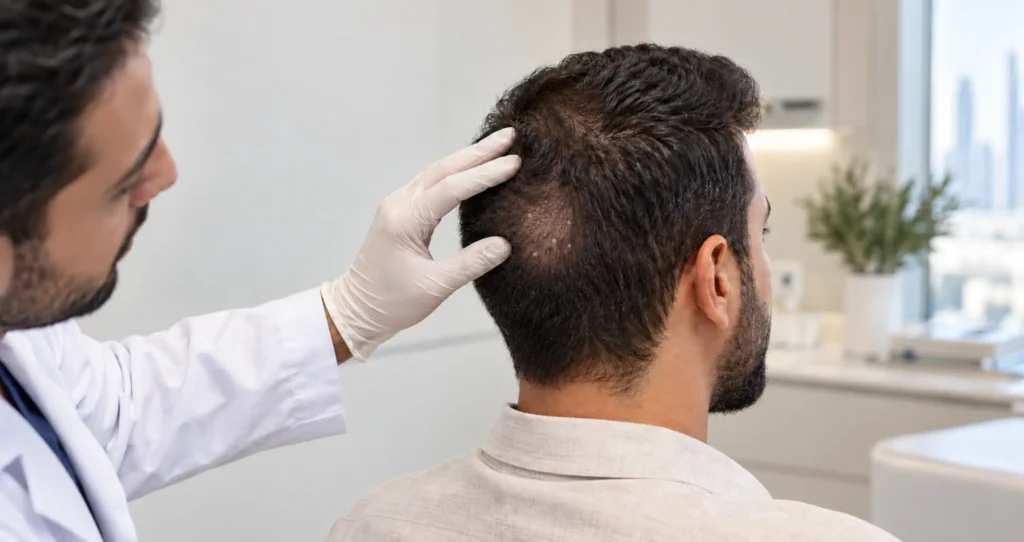
A major appeal of FUE is avoiding a single linear incision in the donor scalp. However, calling it completely scarless is inaccurate. Multiple small extraction scars may remain, and very short hair can make them easier to see. The amount of camouflage depends on surrounding donor density, the person’s hair colour and calibre, skin tone and the extraction pattern. Someone planning to wear a closely shaved style after surgery should raise that preference before treatment rather than assuming FUE marks will always be invisible.
The timing of electric clippers, razors and salon visits must also be cleared by the operating team. Freshly healed skin can be irritated by blades, disinfectants and aggressive styling products. A barber may not know where surgery was performed or what restrictions remain; patients should carry the surgeon’s haircut instructions and communicate them clearly. Appearance is a legitimate consideration, not a superficial concern.
Temporary Shedding Versus Permanent Donor Density Changes
Hair may look sparser near the extraction sites in early photographs for several reasons. The surrounding hair could be clipped short, local inflammation may change how strands lie, and some adjacent hairs may temporarily shed after surgery. At the same time, every harvested follicular unit has physically left the donor area, so a permanent reduction in local follicle numbers is also part of the procedure.
These phenomena should not be conflated. Temporary shock shedding cannot be reliably diagnosed by appearance alone, and not every area will regain its previous visible density. A clinician can assess the harvesting pattern, remaining hair and skin changes, then explain what is likely temporary and what may reflect the original extraction plan. Avoid claims that a special shampoo or supplement can ‘replace’ extracted follicles in the donor zone. Such claims misrepresent what donor recovery actually involves.
Scarring: What FUE Does and Does Not Promise
As the FUE donor area healing timeline progresses, small extraction wounds can mature into scars that may appear as lighter dots against surrounding skin. Scars may be especially noticeable when the donor hair is shaved very short or when skin and hair colour contrast strongly. They may also vary with wound size, healing tendency, tension and individual skin response. FUE is different from the linear strip scar associated with follicular unit transplantation, but neither approach should be described as having no possibility of scarring.
It is reasonable to ask how your surgeon spaces extractions and what photographs show donor areas after full healing, not just immediately after treatment. If the scalp forms raised, painful or unusual scars, seek qualified clinical assessment. Cosmetic camouflage options should be discussed only after the area has healed and the diagnosis of the visible change is clear. An honest explanation supports better consent and realistic styling plans.
Numbness, Itching and Sensory Changes
Itching often accompanies wound healing, but scratching can damage fragile skin and introduce contamination. Numbness or altered sensation can occur when small sensory structures are irritated during surgery. Such symptoms may gradually improve, but a precise timeline cannot be promised. Patients should mention persistent localised pain, increasing sensitivity, burning sensations or numbness that interferes with daily activities. Self-treatment with strong essential oils, skin acids or microneedling over recent extraction sites can worsen irritation and is not a substitute for assessment.
Simple comfort measures should be approved by the clinic because they depend on whether the wounds are still open and which medications are being used. Keep track of whether the symptom is improving, stable or getting worse. That pattern helps the medical team judge whether reassurance, a change in care or further evaluation is appropriate.
Sun, Heat, Sweat and Headwear in Dubai
Recovering in Dubai may mean travelling between intense outdoor heat, air-conditioned buildings and a crowded commute. The immediate concern is not that the climate changes the biology of follicles, but that sun, sweat and friction can irritate vulnerable healing skin. Ask the clinic when it is safe to use approved sun protection or wear loose headwear, and whether a specific hat shape could rub donor and recipient sites.
A hard safety helmet needed for work presents a different practical issue from a loose casual cap. Patients whose job includes prolonged outdoor exposure should discuss their return date in advance. Avoid applying sunscreen to unhealed skin unless the surgeon approves it. Once the area has healed, scalp sun protection remains sensible, particularly where hair coverage is limited. Comfort, wound condition and actual activity should guide the conversation rather than a universal rule.
Sleeping Positions, Pillows and Overnight Friction
Sleeping is one of the few times patients cannot consciously stop themselves from rubbing the scalp. Pillow contact, head turning and certain sleeping positions may place pressure on either the donor region or newly implanted grafts. The surgeon should specify which sleeping arrangement is appropriate for the procedure performed. Do not infer from general online diagrams that everyone needs the same number of pillows or must sleep upright for an identical period.
A clean pillowcase and a comfortable environment may help with routine hygiene, but they do not replace specific instructions. If the donor area is at the back of the head, the medical team may suggest ways to minimise rubbing without sacrificing safe sleep. Patients who have breathing disorders, neck problems or mobility limitations should mention them before leaving the clinic. The recommended position must remain physically safe for the person using it.
Exercise, Gym Sessions and Contact Sports
A short walk and an intense weightlifting session create very different demands. During recovery, vigorous exercise can raise sweating, blood pressure and friction, while contact sports introduce the risk of a direct scalp injury. The timing for each activity should be individualised. Ask separately about desk work, light walking, cardio, resistance training, swimming and sports helmets instead of asking one general question about ‘exercise’.
A surgeon may recommend a gradual return rather than an abrupt move from rest to full training. If activity causes increased throbbing, bleeding, swelling or rubbing, stop and contact the clinic. Avoid treating other patients’ social-media timelines as clearance to train. The NHS notes that hair transplant patients may be advised to reduce exercise early in recovery; the exact period should be established by the treating team. Protecting the recipient area is also part of the decision, even when the donor area looks healed.
How Medical History Changes the Follow-Up Plan
Two patients with similar-looking donor zones can have different risks. Diabetes, smoking, medicines affecting immunity, bleeding disorders, inflammatory scalp conditions, prior scars and previous procedures may change the planning and monitoring required. Patients should disclose relevant conditions before surgery and update the team if a new medication or complication arises.
Do not stop anticoagulants, blood-pressure medicines or other prescriptions based on a website checklist. The clinician responsible for those medicines should be involved where necessary. A high number of extracted grafts, dense harvesting or the need for more than one session also affects how donors are evaluated over time. Individual risk assessment is part of responsible surgery and should be visible in the aftercare plan. If concerns arise, contacting the operating team promptly gives them the best chance to assess the area in the context of the actual procedure.
Warning Signs: A Practical Triage Framework
Normal healing is not defined simply by being able to tolerate discomfort. A patient should know which symptoms are expected, which warrant a routine call and which require urgent care. Mild improving tenderness or small crusts may be monitored according to the discharge instructions. Increased redness, foul-smelling drainage, persistent bleeding, expanding swelling or pain that is becoming worse require prompt contact with the surgical team.
Fever together with local wound changes can indicate infection and deserves medical review. Severe or rapidly progressing symptoms should be assessed urgently. Do not hide new discharge beneath a hat or self-prescribe antibiotics. Photographs can help the clinic decide whether an in-person examination is necessary, but they are not a replacement when symptoms are significant. Before travelling out of Dubai, confirm who can provide urgent in-person treatment if a complication occurs after leaving the country.
Simple Follow-Up Photo Protocol
Photographs are more helpful when taken for a clear reason and under comparable conditions. A useful set can show the back and both sides of the donor scalp from a consistent distance with hair dry and styling unchanged. Bright direct flash may exaggerate redness or tiny pale dots, while shadow can hide them. Patients should not shave the donor area merely to recreate an image or check progress more often than the surgeon recommends.
For clinical concerns, take a closer photograph with enough context to show the location and send it securely to the team. Record the date and any symptoms such as tenderness, itch or drainage rather than attaching a confident self-diagnosis. For cosmetic comparison after several months, consistent length and lighting improve reliability. The purpose is to make follow-up decisions better, not to track each follicle or obsess over minute daily changes.
Checklist Before Your Donor-Area Follow-Up
To help your surgeon evaluate your FUE donor area healing timeline, bring relevant photographs and a concise record of how symptoms have changed. Ask the clinician whether the surface has closed, which products are now safe, when hair can be cut closely, and whether exercise or sun exposure restrictions remain. If you see an uneven appearance, ask whether it reflects extraction spacing, residual inflammation, temporary shedding, or a more persistent donor density change. Confirm whether any altered sensation is expected to improve and when further assessment would be appropriate.
A clear answer should include warning signs and a contact method, not just a statement that recovery is ‘normal’. If additional surgical sessions are being considered, ask how the remaining donor supply will be assessed before discussing graft targets. Good follow-up protects both health and future options. The donor area is a limited resource, and the decision to use more of it deserves deliberate planning.
Donor Healing Versus Recipient Graft Growth: Two Different Clocks
A patient can have a comfortable donor area while still waiting months for visible growth in the transplanted region. The donor skin is primarily recovering from extraction wounds; the recipient region contains grafts that have been moved and must establish themselves in their new sites. The FUE donor area healing timeline should not be confused with recipient graft growth, because scabbing, postoperative shedding and later hair growth do not follow one universal schedule.
This is why an improving donor photograph cannot prove that all transplanted grafts survived, and why delayed visible recipient growth is not by itself proof of donor-area failure. Questions about graft growth should be discussed separately from concerns about scarring or donor density. The NHS describes long-term changes in visible hair transplant results over many months; clinicians should interpret those milestones for the individual patient rather than advertising identical outcomes. Separate expectations prevent unnecessary alarm and make appointments more focused.
FUE Donor Area Healing Timeline: Key Takeaways
The fue donor area healing timeline is best used as a framework for questions rather than a fixed promise. Early crusting and tenderness may settle as the scalp recovers, but scars, sensation and the visible density of remaining hair should be assessed separately. Individual aftercare instructions govern cleansing, headwear, exercise and haircuts. If redness, swelling, pain or drainage becomes worse, contact the surgeon promptly instead of trying unapproved remedies. A careful follow-up examines how the donor area looks and feels, whether the harvesting pattern preserves adequate coverage, and whether any future surgery would be appropriate.
Frequently asked questions
Will the donor area look normal after a week?
It may look improved, but redness or crusting can persist and timing varies.
Is FUE completely scar-free?
No. Small extraction scars can remain, though they are usually less conspicuous than a linear strip scar.
Can I sleep on the donor area?
Follow your surgeon’s positioning advice for your particular procedure.
When can I go back to the gym?
Ask your surgeon, because the safe time depends on the procedure and healing progress.
Next step: Discuss your individual concerns with a qualified clinician. For the related service and consultation information, visit https://www.tuniohairtransplant.com/fue-hair-transplant/
Editorial note: Verify against live WordPress archive, unpublished drafts, Google Search Console, and current clinical guidance before publishing. Do not publish the proposed URL until checks are complete.
Clinical and Editorial Reference Notes
NHS — Hair transplant and recovery
ISHRS — Before choosing a hair restoration surgeon
These resources provide general background for editorial review. They do not certify the safety of an individual procedure or replace instructions from the operating clinician.
Keep reading


