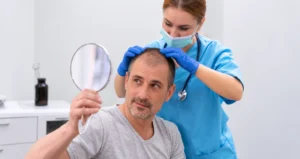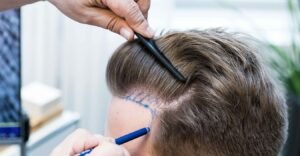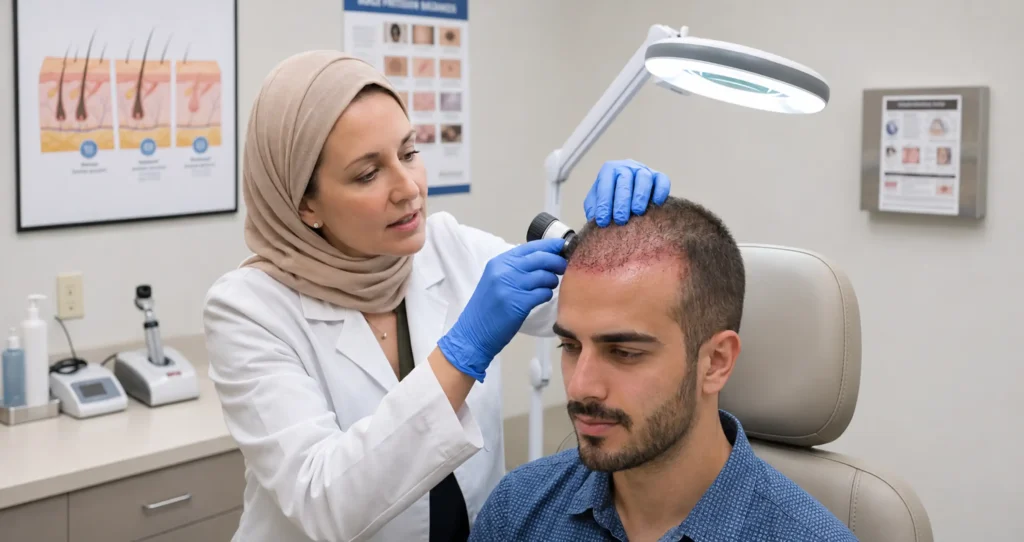
The phrase fue graft survival factors refers to the surgical, biological and early-care decisions that can affect whether transplanted follicles eventually grow. This guide focuses on evidence-aware questions and realistic expectations; it does not supply a guaranteed survival rate or replace individual advice from a qualified surgeon.
Direct Answer: What Influences Graft Survival?
FUE graft survival factors include donor selection, the quality of follicular-unit extraction, tissue handling, time outside the body, recipient-site preparation, placement and care during the early postoperative period. No single product, graft count or marketing label can guarantee survival. A transplanted follicular unit is living tissue; successful growth depends on coordinated clinical steps as well as individual patient factors.
The NHS cautions that transplanted grafts need particular protection during early recovery and acknowledges the possibility that transplantation may not take as expected. That is different from saying every loose hair or temporary shed means a graft was lost. Patients should ask the surgeon how follicles are harvested and protected, which steps are performed by qualified professionals and what follow-up is included. This guide explains mechanisms and questions, not a numerical survival prediction for a particular clinic or patient.
Start With a Correct Hair-Loss Diagnosis
A procedure can be technically careful yet unsuitable if the underlying diagnosis is wrong. FUE is commonly considered for selected types of permanent patterned thinning, but active scarring alopecia, diffuse shedding or unstable inflammatory conditions may require another approach. The first survival-related question is therefore whether transplantation is appropriate at all.
If the scalp is inflamed or the donor region itself is affected by a disorder, the long-term result may be unpredictable. A qualified clinician should review pattern, history, medications and scalp findings before discussing graft allocation. This step also prevents a patient from assuming that surgery treats the process that is still reducing nearby native hair. Properly placed grafts do not stop existing hair from thinning. A realistic plan may involve disease management or monitoring before any surgical work begins. A correct diagnosis is fundamental to understanding FUE graft survival factors because it informs surgical safety, donor conservation and the eventual assessment of outcomes.
| Key consideration | What the article explains |
| Start With a Correct Hair-Loss Diagnosis | A procedure can be technically careful yet unsuitable if the underlying diagnosis is wrong. |
| What Does Transection Mean? | Transection occurs when part of a follicular unit is cut during extraction. |
| Why Hydration and Temperature Management Matter | Once follicles are outside the scalp, they are no longer being nourished in the same way as intact tissue. |
The Donor Area Is a Limited Biological Resource
A transplanted follicular unit must come from somewhere. FUE typically obtains units from the back or sides of the scalp, but density, calibre, stable coverage and previous harvesting vary between individuals. Removing too many units from a limited region can create cosmetic thinning or expose numerous extraction marks. When considering FUE graft survival factors, the goal is not to maximise the number of grafts extracted in a single session.
It is choosing suitable donor areas while conserving enough healthy coverage for long-term appearance. Hair calibre and curl may influence how much visual coverage a given number of grafts provides, so a raw graft count is an incomplete metric. Patients should ask how donor density is assessed and how the proposed number relates to the recipient goal. Future loss and the possibility of another session matter too. Once removed, follicles do not automatically regenerate in the donor site.
For an introduction to the method rather than the factors that may affect graft growth, read Tunio’s FUE procedure overview for Dubai patients.
Extraction Skill and Tissue Preservation
During follicular unit extraction, the surgical team must separate living follicular units from the surrounding scalp while minimising avoidable damage. A graft that is cut or traumatised during harvesting may be less viable, although injury is not always visible to a patient reviewing a photograph. Important technical FUE graft survival factors include the extraction instrument, surgical technique and operator skill, alongside individual hair angles and local scalp anatomy. Curly, coarse or previously operated hair can require particular planning.
Modern terminology and branded equipment should not be treated as proof of better outcomes by themselves. Patients need to know who actually harvests grafts, their qualifications and whether the process is supervised appropriately. Ask how the team monitors the quality of extracted units and what the surgeon does if conditions differ from the preoperative estimate. A careful explanation is more meaningful than a promise that every graft will survive.
What Does Transection Mean?
Transection occurs when part of a follicular unit is cut during extraction. Transection is relevant to FUE graft survival factors because living follicles can be damaged when the extraction instrument does not follow their direction or depth appropriately. The appearance of hair shafts above the skin does not always reveal the full course of the follicle beneath it. This can make the procedure more challenging in some hair types and scalp regions.
Patients may hear clinics discuss low transection rates, but those numbers need context: how they were measured, which patients they reflect and whether they describe all extracted units or only selected observations. An advertised percentage should not be interpreted as a guarantee of final growth. The surgical team can explain how it plans extraction around individual hair characteristics. A responsible consultation focuses on technique, operator competence and donor preservation rather than a single unsupported performance statistic.
The Time Between Extraction and Implantation
Follicular units are living tissues that may spend time outside their natural blood supply between harvesting and placement. Among the FUE graft survival factors that surgical teams must consider are protection against avoidable drying, heat and prolonged exposure between extraction and implantation. Handling protocols, appropriate holding conditions and efficient coordination among staff matter, but precise acceptable times and temperatures cannot be specified for a particular operation without knowing the technique. Patients should ask who manages harvested tissue, how units are identified and counted, and what quality-control steps are used before placement.
Do not assume that a longer session necessarily means poor handling or that a faster session guarantees success. The relevant issue is whether the team has a coherent medical process for maintaining tissue viability while respecting patient comfort and safety. A clinic should be able to explain the protocol in understandable language.
Why Hydration and Temperature Management Matter
Once follicles are outside the scalp, they are no longer being nourished in the same way as intact tissue. Hydration and appropriate storage conditions are important FUE graft survival factors because drying and unsuitable conditions can place avoidable stress on harvested follicles. Clinical teams may use appropriate solutions and temperature controls according to their chosen technique, but the exact method is a surgical responsibility rather than a home aftercare task. Marketing claims about a proprietary liquid should be supported by evidence rather than presented as a universal reason for guaranteed growth.
Ask whether the clinic has consistent graft storage and monitoring procedures, especially during a long procedure. Patients should not attempt to purchase or administer a graft-preservation product independently after surgery. Once grafts are implanted, care shifts toward protecting the healing scalp and following the surgeon’s discharge instructions. The distinction between ex-vivo tissue handling and postoperative scalp care is important when evaluating claims.
For practical preoperative questions, the clinic’s hair transplant preparation guide covers a separate phase of care; confirm each medical instruction with your own team.
Recipient-Site Planning and Blood Supply
Recipient sites must be created with attention to scalp anatomy, natural hair direction, existing follicles and the intended cosmetic design. Placing grafts too aggressively into an area without considering tissue condition can create avoidable injury. When assessing FUE graft survival factors during recipient-site planning, the clinician should account for scars, previous operations and inflammatory scalp disease that may affect suitability. Hairline and crown regions have different directional patterns, which matters both to appearance and implantation technique.
The patient’s primary concern may be density, but a natural-looking result depends on distribution as well as graft quantity. Ask how the proposed site plan balances coverage with donor limits and how complications would be managed. No online article can establish the safe density for a particular patient from a photo alone. Recipient planning is a surgical judgement, not a calculator that guarantees a fixed number of new hairs.
Placing Grafts Without Unnecessary Trauma
Implantation requires careful handling so that follicular units enter prepared sites in appropriate orientation and position. Careful implantation is central to FUE graft survival factors, particularly when minimising crushing, repeated manipulation and drying of follicular tissue. The surgical team should have an organised system for communicating graft characteristics and distributing units across the recipient region. The exact instruments can vary by technique; choosing one fashionable tool does not prove that all other methods are inferior. Ask which clinical professional performs placement and how the surgeon supervises the work.
Some clinics emphasise that a particular device allows very dense packing, but a patient’s scalp, donor resources and vascularity still impose limits. Realistic expectations should include the possibility that some grafts may fail to grow despite appropriate care. Ethical communication describes risks and limitations rather than claiming near-perfect survival under all conditions.
The Role of Surgeon and Team Experience
Surgical team coordination and professional expertise are important FUE graft survival factors throughout the procedure. The person responsible for diagnosis and surgical planning should be identifiable, as should everyone performing harvesting, recipient incisions and placement. Patients can ask about relevant experience, facility licensing and handling of complications. A clinic advertising a celebrated doctor’s name should explain whether that doctor will directly perform or supervise key stages, rather than relying on a photograph or signature.
Team size alone does not establish quality. An organised team can be beneficial, but staffing roles and legal scope of practice matter. A patient should receive candid answers about who touches the scalp and who makes clinical decisions if circumstances change. These questions help evaluate competence without pretending that a particular promotional title predicts a measurable survival rate.
Medical Conditions and Healing Capacity

Diabetes, smoking, certain medicines, scalp inflammation, circulation problems and other medical conditions may affect procedural planning or recovery. When assessing FUE graft survival factors, clinicians must consider individual health risks, medical history and appropriate medication management. Do not stop prescribed medicines without consulting the responsible clinician. A person with a history of slow wound healing or troublesome scars may need a different plan from a healthy adult without those issues.
Surgery also involves anaesthesia considerations, infection prevention and general postoperative safety, none of which are captured by a simple graft-survival percentage. Ask what the surgeon expects to influence healing in your case and whether treatment should be postponed until another condition is addressed. Managing health risks is part of responsible transplantation, not an optional extra after the hairline design has been agreed.
Early Aftercare: Protecting the Recipient Area
Postoperative protection is another important consideration among FUE graft survival factors, as newly transplanted grafts require particular care during initial recovery. The NHS advises patients to be very careful with transplanted hair for approximately the first two weeks and to follow the surgeon’s instructions. That guidance is a broad patient resource, not a personalised washing or exercise schedule. Avoid picking scabs, scratching the recipient area or rubbing it against pillows, helmets or tight clothing.
Use only the cleaning and prescribed products recommended by the operating team. If there is bleeding, an obvious injury or unexpected severe pain, contact the clinic rather than guessing how many grafts might have moved. Protection of the recipient area reduces avoidable trauma but does not guarantee that every graft will eventually produce visible hair. The surgeon should explain practical precautions and when normal activity may resume.
The site’s common transplant questions resource can help patients understand broader procedure expectations without assuming any specific survival rate.
Washing and Scabs Are Not a Survival Calculator
Small crusts commonly form around the implant sites during healing. Their appearance and how quickly they loosen vary, and they do not independently measure whether a follicular unit is viable. A hair shaft attached to a crust is not automatically proof that a full graft has been lost. Likewise, a clean-looking scalp during the second week does not establish that every transplanted follicle will grow.
The clinic should provide washing instructions suited to its technique, including which products to use and how much contact is permitted. Never scrape off crusts merely to make a photograph look better. If a scabbed region develops spreading redness, drainage or increasing pain, a clinician should evaluate the wound. Questions about normal crusting belong to early postoperative care, while longer-term growth requires separate follow-up months later.
Shedding of Transplanted Hair Can Be Expected
Patients often panic when short transplanted hairs shed weeks after surgery. The NHS notes that transplanted hair commonly falls out after a few weeks and that later growth is a separate process. The visible shaft and the follicular unit are not the same thing. Temporary shedding therefore does not automatically mean the graft died. At the same time, no patient can determine the final success of every unit from the shower drain or a close-up photo.
The surgeon may monitor the scalp over months and distinguish normal postoperative shedding from complications. A sudden large change accompanied by pain or inflammation deserves medical advice, whereas slow visible growth is part of a longer assessment. Setting expectations before surgery is one of the most helpful ways to reduce anxiety about normal-looking but alarming stages of recovery.
Shock Loss and Native Hair Changes
Shock loss refers to shedding that may affect some existing hair near the operated region. It can make coverage appear temporarily worse even when graft placement itself is intact. The mechanism, likelihood and recovery depend on individual factors, so a general blog should not claim that every shed native hair will return. A patient should discuss how the surgeon expects the operation to affect surrounding miniaturised hair, particularly when hereditary loss remains active.
The risk also reinforces the importance of realistic density planning and possible ongoing medical management where appropriate. Shock loss is not identical to donor overharvesting, transection during extraction or later failure of a transplanted follicle to grow. Separating these issues helps patients ask clearer follow-up questions and prevents a single short-term photograph from being used as a verdict on surgical success.
Infection, Bleeding and Other Warning Signs
Hair transplant surgery carries a small risk of infection, bleeding, anaesthetic reaction and other complications, as described by the NHS. Mild discomfort or scabbing can occur without indicating danger, but increasing severe pain, spreading redness, fever, unusual discharge or persistent bleeding require attention. Patients should have an accessible after-hours clinic number and know when urgent in-person care is needed.
Do not take leftover antibiotics or apply strong antiseptics without appropriate guidance. If a patient travels out of Dubai soon after surgery, arranging local medical access becomes especially important. Complications can influence healing and the treatment experience, yet an online article cannot diagnose them from a photograph. Clear written instructions and prompt assessment are more useful than a promise that the procedure has zero medical risk.
What a Survival Percentage Does—and Does Not—Tell You
A clinic may advertise a percentage of graft survival, but a number is only meaningful if its definition, measurement technique, patient population and follow-up interval are clear. Counting extracted units differs from documenting later visible growth, and photographic density is influenced by hair calibre and styling. Individual FUE graft survival factors, including donor supply and scalp condition, limit the applicability of claims based on selected cases.
Ask whether the number is an internal audit, a published study or marketing language. If clinical evidence is cited, does it evaluate the same technique, medical team and population? Avoid formulas that convert a stated survival percentage into a guaranteed number of new hairs. Realistic patient counselling includes uncertainty and acknowledges that even careful procedures can have variable outcomes.
Why Final Results Take Longer to Judge
Surface wounds can settle long before transplanted follicles produce visible hair. The NHS describes visible growth emerging over months and full results often requiring a much longer interval than the first few weeks. Timing varies, and one person’s progress photograph is not a universal benchmark. Short haircuts, different lighting and continued native loss can further alter appearance.
A clinic should schedule meaningful follow-up and explain what each visit can evaluate: wound healing early on, scalp health later and cosmetic density when enough time has passed. A patient cannot diagnose a failed graft after one month because no visible strand has yet emerged. Likewise, early strands do not establish that the final density will match a digital simulation. Patience should be paired with appropriate medical monitoring rather than an invented fixed result date.
When comparing providers, the published clinic selection guide can be used as navigation; surgeon roles and official licensing still require individual verification.
Questions to Ask Before Booking FUE
Ask whether the diagnosis and donor region are suitable, what graft range is planned and how the extraction pattern will protect remaining donor density. Request the names and qualifications of professionals performing harvesting, site creation and implantation. When discussing FUE graft survival factors, ask how the surgical team stores and handles grafts and whether it records the condition of extracted units. Clarify who is responsible for infection management and how follow-up works if travelling.
Discuss scarring, shock shedding, continuing native hair loss and what would happen if the final cosmetic result is below expectations. These questions provide more useful context than a guarantee of ‘100 percent success’. Patients can obtain a second opinion if the plan is unclear or unusually aggressive. A proper consultation should explain both opportunities and limits without coercive sales tactics.
Frequently Asked Questions
Does FUE always result in graft survival?
No. Surgical outcomes vary, and no responsible clinician can guarantee every follicular unit will grow.
Is FUE scar-free?
No. It usually avoids a long strip scar but creates small extraction scars.
Does a shed transplanted hair mean a graft died?
Not necessarily; shedding of shafts can occur before new growth.
Can too many grafts be removed from the donor?
Yes. Overharvesting can damage the donor area’s appearance.
Do scabs prove follicles are secure?
No. Scab appearance is not a survival test.
Do special devices guarantee a higher rate?
Claims require evidence for the specific technique and context.
When should I assess the result?
Over months, according to clinician follow-up rather than early pictures.
Can I wash immediately?
Follow the operating surgeon’s written procedure-specific instructions.
Final Perspective: A Chain of Clinical Decisions
Understanding FUE graft survival factors requires considering the entire chain of clinical decisions, from diagnosis and donor selection through extraction, tissue handling, implantation and recovery. There is no independent home test that can convert early shedding or crusts into a reliable survival percentage. Patients should prioritise qualified surgical responsibility, appropriate donor conservation, careful handling and a realistic long-term plan.
The NHS recognises the possibility of failed take, complications and continued thinning of native hair, which underscores why honest consent matters. If unexpected pain, bleeding, fever or discharge occurs, seek medical review rather than waiting for a promotional timeline. A sound FUE discussion explains risks, uncertainty, how follow-up works and the reasons a plan is appropriate for that individual. Outcomes should be judged with the treating clinician over a suitable period, not by marketing promises.
EVIDENCE AND REFERENCE NOTES
NHS — Hair transplant: preparation, recovery and risks
ISHRS — Verify who is operating on you
Dubai Health Authority — Sheryan professional and facility licensing
The sources provide general regulatory and clinical context rather than a quantified survival promise for Tunio or an individual surgeon.
Keep reading