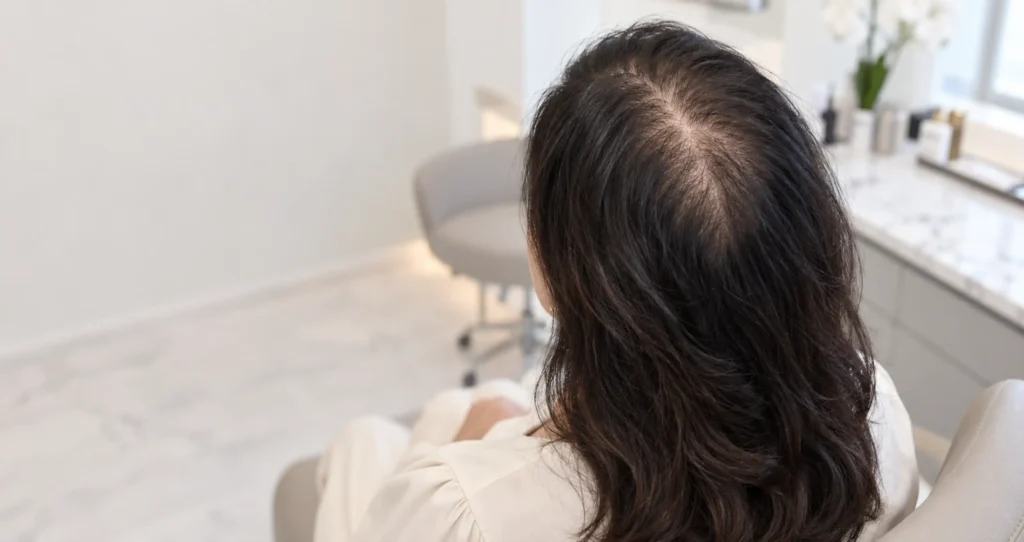
Female hair thinning at crown is a search phrase used by people trying to understand changes at the top of the scalp. An isolated patch of visible scalp does not establish a diagnosis; this guide explains the signs to observe, causes to discuss, and situations that warrant an examination. For a general overview of Tunio’s hair-loss care and consultation approach, see female hair thinning at crown. Different causes require different treatment choices, and no online article can confirm an individual’s condition.
Direct Answer: Why the Crown Looks Thinner
Female hair thinning at crown can describe a widening part, increased scalp visibility around the natural whorl, or a broader reduction in density over the top of the head. It is an observation, not a diagnosis. Common explanations include female pattern hair loss, temporary shedding after a physical stressor, nutritional or thyroid problems, and inflammatory scalp conditions.
The first step is to establish whether the change is gradual or sudden and whether the scalp itself is healthy. A dermatologist may examine hair calibre, density, the pattern of thinning and relevant medical history before suggesting tests or treatment. One photograph taken under strong overhead lighting is not sufficient to establish progressive loss. Early assessment is particularly important when a woman sees a persistent widening part or new thinning that continues across several months. The aim is to identify the cause rather than rush toward a particular procedure.
What Counts as the Crown?
When assessing female hair thinning at crown, it helps to understand that the crown is the upper rear portion of the scalp around the vertex, where hair naturally forms a whorl. That swirl matters because strands travel in different directions and expose small areas of skin even in people with healthy density. A prominent whorl can look alarming when photographed directly from above, especially with wet hair, flash or bright overhead lighting.
True thinning is more convincing when there is a sustained change from a previous baseline rather than one static image. Women sometimes describe the entire top of the head as the crown, although the mid-scalp part and frontal region may also be involved. During an examination, the clinician can distinguish those zones and determine whether changes are widespread, central or limited to a specific spot. This prevents confusing an ordinary hair-growth pattern with a new medical condition, and it helps choose consistent photo angles for monitoring.
Widening Part Versus Isolated Crown Visibility
A widening central part is a frequent early feature to investigate when evaluating female hair thinning at crown, although it does not establish a diagnosis on its own. Someone may first notice that the line of scalp visible between parted hairs becomes broader, or that styling no longer creates the same fullness. An isolated glimpse of scalp at the whorl, however, may occur without disease. Compare photographs only when the hair is dry, similarly styled and photographed under the same lighting.
A ponytail pulled tightly back can change the apparent shape of a part, while hair oil or conditioner can make strands clump together and reveal more scalp. The most useful question is not whether any scalp is visible but whether the pattern is changing consistently. In some women, the part widens gradually without marked shedding. Others report shedding but no change in patterned density. Both scenarios deserve different clinical questions and should not be treated as interchangeable.
Female Pattern Hair Loss and Follicular Miniaturisation
Female pattern hair loss is a common, often hereditary explanation for female hair thinning at crown, particularly when density gradually decreases over the top of the scalp. Susceptible follicles progressively produce finer hairs, which can make previously dense areas look more transparent. The American Academy of Dermatology describes widening of the part and overall thinning as typical signs, while the frontal hairline may remain relatively preserved.
Genetics can be inherited from either parent; a family history is helpful but not necessary to confirm the diagnosis. Hormonal influences may play a role, yet a single hormone test does not diagnose every case. Some women have a combination of hereditary thinning and another shedding condition. Treatment discussions depend on the degree of progression, the patient’s health and reproductive plans. The fact that female pattern hair loss may be progressive is a reason for timely examination, not a reason to assume that complete baldness is inevitable.
Shedding After Illness Is a Different Question
When investigating female hair thinning at crown, clinicians may consider telogen effluvium, a form of increased shedding that can occur after fever, illness, surgery, major stress, nutritional changes or other physiological events. It frequently affects the scalp more diffusely than a localised crown pattern. A woman may see more hair in a brush or shower without the characteristic gradual changes in hair diameter associated with patterned thinning. Shedding can also temporarily reveal an existing tendency toward female pattern hair loss. Timing matters: ask when a possible trigger occurred, when excess shedding began and whether the rate is still changing.
Not every episode of stress causes telogen effluvium, and not every person with shedding needs the same blood tests. A clinician can help interpret the history and avoid unnecessarily blaming ordinary daily events. The topic of stress-associated shedding is discussed separately in the site’s article about stress-associated shedding, rather than turning this crown-focused guide into a general stress management article.
| What you notice | A possible explanation | Useful next step |
| Part gradually looks wider | Pattern hair loss may cause follicular miniaturization. | Compare consistent photos; discuss a scalp examination. |
| Sudden diffuse shedding | A temporary hair-cycle shift is possible after a trigger. | Review onset, illness, medicines and nutrition with a clinician. |
| Pain, redness or scaly patches | Inflammatory or other scalp conditions need consideration. | Arrange a timely dermatologist assessment. |
Hormonal Changes and the Value of a Clinical History
Hormones influence hair cycling, but attributing every case of female hair thinning at crown to a ‘hormonal imbalance’ is too vague to guide appropriate clinical care. Menstrual history, menopause status, pregnancy and recent childbirth, contraceptive changes, and symptoms such as acne or increased facial hair may provide useful context. Some women with polycystic ovary syndrome develop scalp thinning alongside other features, but not every woman with a thinning part has PCOS. Likewise, menopause can coincide with changes in hair density without providing a complete diagnosis by itself.
A dermatologist or appropriate healthcare professional decides whether endocrine investigation is indicated. Online supplements marketed as hormone balancing are not a substitute for evaluating symptoms, and self-prescribed medicines can be inappropriate or unsafe. Clear communication about medications, current health and plans for pregnancy helps shape the treatment options that can reasonably be considered.
Iron, Thyroid Health and Nutritional Considerations
When investigating female hair thinning at crown, iron deficiency, thyroid disease and inadequate dietary intake may be considered, but these possibilities require appropriate clinical assessment rather than assumptions. The American Academy of Dermatology notes that testing may be indicated when a dermatologist suspects an underlying medical condition or deficiency. A woman who experiences fatigue, substantial dietary restriction, heavy menstrual bleeding or other relevant symptoms should tell the clinician. Over-the-counter iron and high-dose vitamins are not harmless simply because they are sold for hair.
Excessive supplementation can cause adverse effects, and some tests are not meaningful without a medical history. A balanced, adequate diet supports general health, but it cannot reverse every genetically influenced follicle change. The practical priority is to correct documented deficiencies when present and to distinguish them from conditions requiring different treatment.
Pregnancy and Postpartum Hair Changes
When evaluating female hair thinning at crown during pregnancy or after delivery, clinicians should consider changes in the hair-growth cycle and other possible causes. Postpartum shedding commonly becomes noticeable months after birth and may resolve as cycling normalises, although a woman can also have underlying female pattern hair loss. The timing, rate of shedding and presence of a widening part help the clinician interpret the picture.
Pregnancy and breastfeeding also affect which medications can be considered safe. Do not use a product recommended for another adult or continue a prescription without discussing it with the relevant clinician. This article focuses on recognition of crown thinning rather than giving a full postpartum recovery timeline; a dedicated postpartum guide is the more appropriate location for that distinct intent. Persistent patchy loss, marked scalp inflammation or other worrying symptoms should prompt assessment regardless of whether childbirth was recent.
Traction, Styling and Heat-Related Breakage
Tight hairstyles that continually pull on follicles can cause traction alopecia, often more noticeable near the hairline but potentially affecting other stressed areas. Chemical processing, excessive heat and harsh brushing may contribute to breakage that changes the way hair covers the crown. Broken shafts are not the same as follicle miniaturisation, and the remedies are different.
A clinician may look for short broken hairs, variation in shaft thickness, scalp inflammation and the distribution of tension. Avoid attributing all thinning to water quality, air conditioning or the weather without evidence. Practical changes such as reducing repeated pulling and limiting harsh manipulation can help protect fragile hair, but they will not diagnose or cure every cause of thinning. It is worth discussing a usual styling routine honestly because a pattern of tension may not be obvious in clinic photographs.
When Scalp Symptoms Change the Assessment
When female hair thinning at crown occurs alongside itching, scaling, burning, redness, pustules, tenderness or smooth shiny patches, these symptoms require careful clinical attention. Some inflammatory and scarring hair disorders require timely treatment to prevent lasting damage, and the early appearance can be confused with other causes. A clinician may examine the scalp with magnification and consider further investigations when the history warrants them.
If a new patch becomes rapidly larger, or pain and inflammation accompany thinning, do not wait for a long photographic monitoring period before seeking care. Heavy scratching and unverified strong scalp acids can worsen discomfort. Shampoos may help certain scalp conditions, but the right option depends on the actual diagnosis. An article about common female pattern loss should never imply that all painful or inflamed crown changes are harmless hereditary shedding.
How to Take Comparable Crown Photos
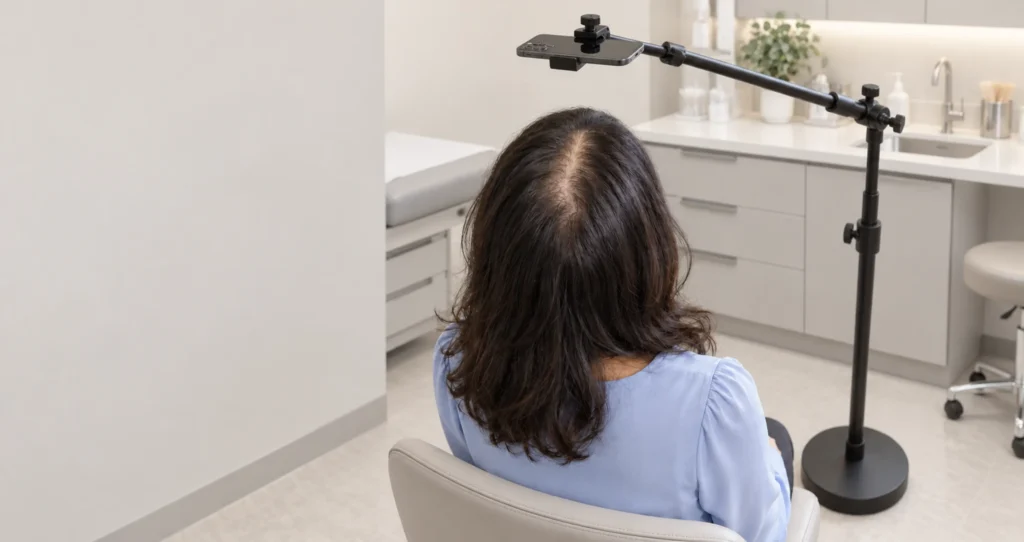
To monitor female hair thinning at crown, choose consistent, diffuse lighting and photograph the crown directly above, the central part and the frontal view. Keep camera distance, hair dryness, hairstyle and colour settings as similar as possible. A phone held too near the scalp can exaggerate the natural whorl, while fluorescent lighting can highlight gaps that are less visible in ordinary conditions. Label photographs by date and avoid judging individual days. Monthly or every-few-month comparisons can be more informative than constant mirror checking.
A clinician may suggest a different schedule based on the condition. Avoid thickening fibres and highly reflective styling products during comparison shots, because their coverage effects can conceal underlying changes. Photographs are aids to discussion, not validated measures of follicular density; clinical examination remains necessary when the pattern is unclear.
What Happens During a Hair-Loss Examination
When evaluating female hair thinning at crown, a dermatologist usually reviews when the change began, possible triggering illnesses, associated symptoms and how the hair has behaved over time. Examination may include the scalp, hair shafts, eyebrows and nails depending on the suspected condition. A gentle hair-pull test, magnification or trichoscopy may be used to identify useful patterns. Blood tests or a biopsy are not routine for everyone; they are considered when the examination suggests a particular underlying problem.
A patient should ask what the working diagnosis is and what evidence supports it. If the answer is uncertain, a follow-up plan may be more appropriate than immediately choosing a procedure. The site’s questions for a hair-loss specialist can help organise an appointment while keeping this article focused on recognising thinning at the crown.
Medical Treatment Discussions After Diagnosis
After diagnosing the cause of female hair thinning at crown, a dermatologist may discuss evidence-based options such as topical minoxidil for suitable patients with female pattern hair loss. It may take months of consistent use to assess benefit, and scalp irritation or unwanted hair growth can occur. Some women may be considered for prescription treatments, but suitability depends on health conditions and pregnancy potential; no medication is right for everyone. Early transient shedding can occur with certain treatments, which should be discussed before use.
Treatment may be unnecessary when a temporary shedding condition is resolving on its own. The clinician should explain what improvement would mean: slowing progression, increasing density, reducing shedding or treating an underlying deficiency. Avoid guarantees of full restoration or fixed results by a particular date. This introductory section intentionally leaves detailed product comparisons to separate treatment-focused resources.
Why Hair Transplantation Is Not the Default First Step
Female hair thinning at crown does not automatically make someone a suitable candidate for hair transplantation, because diagnosis and donor-hair suitability must be assessed first. Transplantation moves selected follicles from a donor region into a recipient area, which only makes sense if donor hair quality and the underlying diagnosis support it. Diffuse thinning can reduce the reliability of the donor supply, and active inflammatory disease may need management first.
Future progression of untreated hair also matters. A surgeon needs to discuss scarring, graft survival, costs and recovery rather than promise that a dense crown can be guaranteed. Patients who are still being evaluated for a temporary shedding condition may be better served by diagnosis and follow-up before considering a procedure. A woman’s preference for maintaining a particular hairstyle is legitimate and should be part of discussion. The clinic’s guide to female-pattern hair loss and care provides broader treatment context rather than replacing a tailored examination.
Separating Hair Density From Hair Volume
Two women with similar follicle numbers can have hairstyles that appear very different. Hair-shaft diameter, curl, colour contrast, length, humidity and how the part is positioned all affect visible volume. A change in a salon product or haircut can make the crown look flatter without implying sudden follicle loss. Conversely, styling products can hide gradual progression, delaying recognition. The purpose of careful observation is not to judge appearance constantly but to identify persistent changes in the underlying coverage pattern.
When assessing progress after treatment, avoid switching simultaneously between radically different hair lengths and lighting setups. A clinician may measure density or use standardised photography, but no home photograph can establish a precise percentage of regrowth. A sensible plan uses symptoms, objective examination and patient goals rather than one visually impressive image.
Daily Hair Care Without Excessive Promises
Gentle cleansing, conditioning appropriate to the hair type and avoidance of repeated tight tension can support comfort and reduce breakage. None of these steps should be sold as a guaranteed cure for female pattern hair loss. Use scalp products cautiously when the skin is irritated, and avoid layering multiple active solutions at once without professional advice. If a product stings, causes a rash or produces persistent itching, seek guidance before continuing.
Women with textured or chemically treated hair may need to adapt cleansing and styling practices to preserve shaft integrity, but the medical diagnosis is independent of cosmetic preferences. A hair-care routine should make daily life easier and protect remaining hair, not create an exhausting schedule of unproven remedies. Keeping the routine simple can make it easier to identify which product, if any, is causing irritation.
Planning for Dubai Weather and Lifestyle
Hot weather, sweating, frequent showers and head coverings can change how hair looks and feels, but they do not by themselves establish the cause of progressive crown thinning. Humidity can make strands clump, while a dry indoor environment may increase perceived brittleness. Women who cover their hair or wear protective helmets can discuss comfort and avoidance of excessive tension without implying that ordinary head covering causes genetic hair loss.
If using a prescribed scalp treatment, follow the specific directions for application, drying and contact with skin or fabric; do not invent timings from social-media routines. Travelling can disrupt normal hair care and photography, so compare changes over longer periods instead of daily snapshots. When scalp inflammation or shedding persists, medical assessment matters more than changing dozens of cosmetics.
Questions Worth Asking at the First Appointment
Write down when the crown began looking thinner, whether the centre part is changing, whether shedding became more noticeable and whether any illness, childbirth, medication or dietary change occurred beforehand. Ask: Is this female pattern loss, temporary shedding, breakage or another scalp condition? Do I need blood tests? Is the donor hair relevant at this stage? Which treatment options have evidence for my diagnosis?
What side effects or pregnancy-related precautions matter? When should progress be reviewed? If the clinician recommends a medicine, request written instructions and ask what would count as benefit. If the likely cause is temporary, ask what would prompt re-evaluation. Good questions make an appointment more productive than asking for a single quick fix from an advertisement.
Frequently Asked Questions About Female Crown Thinning
Is a visible crown swirl always hair loss?
No. A natural whorl can expose scalp, especially under bright light.
Does a widening part prove female pattern hair loss?
It is a clue but other causes can overlap, so diagnosis is important.
Can women have hereditary thinning without a family history?
Yes, a recognised family history is not necessary in every case.
Can iron supplements fix crown thinning?
Only when an appropriate deficiency or medical reason has been identified; indiscriminate supplements can harm.
Is all crown thinning due to menopause?
No. Menopause can coincide with changes, but other causes should be considered.
Should I start minoxidil immediately?
Discuss diagnosis, pregnancy plans, contraindications and expectations with a qualified clinician.
Is surgery the best solution?
Not necessarily. Suitability depends on the diagnosis, donor supply and long-term progression.
How can I track the change?
Use consistent photos taken at sensible intervals and discuss them with a clinician.
Final Perspective: Diagnose Before Treating
Female hair thinning at crown can be concerning, but its interpretation depends on the pattern, duration, associated symptoms and findings from a clinical examination. A widening part over months may suggest female pattern hair loss; abrupt shedding after illness or childbirth points toward different considerations. Scalp pain, inflammation or patchy loss warrants prompt assessment rather than reassurance from a generic article.
The American Academy of Dermatology emphasises that effective treatment starts with identifying the cause, and not every patient needs the same intervention. Bring a clear timeline, avoid unverified promises and use consistent photographs to support discussion. The most useful next step is a clinical assessment and a realistic, individualised plan—not an assumption that a specific shampoo, supplement or surgery will solve every form of crown thinning.
For related information without repeating the same exact search intent, explore Tunio’s guide to female-pattern hair loss and care. Use that article as background and confirm any medical recommendations with a qualified professional.
For related information without repeating the same exact search intent, explore Tunio’s explanation of androgenetic alopecia. Use that article as background and confirm any medical recommendations with a qualified professional.
For related information without repeating the same exact search intent, explore Tunio’s article about stress-associated shedding. Use that article as background and confirm any medical recommendations with a qualified professional.
For related information without repeating the same exact search intent, explore Tunio’s questions for a hair-loss specialist. Use that article as background and confirm any medical recommendations with a qualified professional.
MEDICAL SOURCE NOTES
American Academy of Dermatology: Female pattern hair loss
American Academy of Dermatology: Diagnosis and treatment
American Academy of Dermatology: Causes of hair loss
These sources support broad clinical statements; they do not endorse a specific commercial treatment. Consult updated guidance and a clinician before publication.
Keep reading