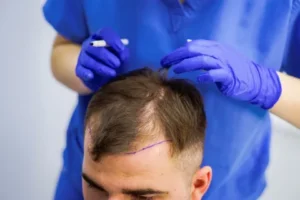
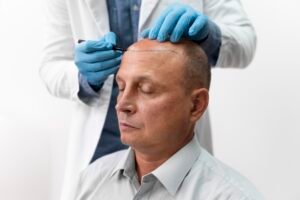
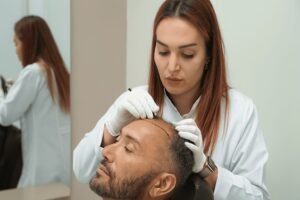
While scalp hair loss is probably the most common area of concern for patients, hair can be lost from any place on the body. Natural aging, disease processes, or trauma can cause hair loss on the face, body, eyebrows, and eyelashes. For some patients, this can cause a level of concern, but fortunately, there are options for rejuvenation. The same techniques used to transplant hair in the scalp can be used for facial hair transplants, eyebrow transplants, and body hair transplants.
Any hair from any part of the body can be transplanted to any other part of the body. Patients must remember that transplanted hair will maintain the characteristics that it had before transplant. This means that the hair will grow according to the same cycle, obtain the same color, and have the same texture. The can be problematic for transplant between certain areas. Patients should be aware that hair on different parts of the body has different growth cycles. This means that eyebrow hair does not grow as long as scalp hair. If scalp hair transplants to the eyebrows, the transplanted hair will have to be trimmed. Alternately, if body hair is transplanted to the scalp, it will not grow as long as natural scalp hair, so the natural hair will have to be trimmed shorter.
Eyebrow Transplants
Donor hair for eyebrow transplant usually comes from the scalp. A large density of hair is reԛuired for eyebrow transplant procedure to make them look natural and 2,000 or more grafts for both eyebrows is not unreasonable in some situations. Placement is key and requires a regularly irregular pattern to obtain natural appearing results. After eyebrow transplants, the hair will have to be shaved, or a ponytail can result.
Facial Hair Transplant
Mustache and beard replacement is possible with facial hair transplants. The donor site is again the scalp and either FUE or strip donor excision can be undertaken. The pattern of placement for facial hair transplants must be regularly irregularly. Large numbers of grafts can sometimes be needed for facial hair transplants owing to the large surface area to be transplanted.
Body Hair Transplant
Chest hair or pubic hair can be replaced with hair restoration procedures. Again, scalp hair is the usual donor site, and grooming is necessary to produce natural appearing results.
The Pros and Cons of Undergoing a Hair Transplant
The Pros
The main ‘pro’ or benefit of a hair transplant is that it is a hair replacement solution that it involves transplantation of your own natural hair and growth usually occurs as normal. You need not worry about color matching hair or hair not behaving in the same way as your own. Growth will resume within 6-8 weeks of surgery, depending on the type of transplantation you opt for. An additional pro is that hair transplant technology has advanced significantly. Individuals can now choose from the traditional FUT technique (Follicular Unit Transplantation) which involves taking a ‘strip’ of hair from the back of the head, dividing the tissue into follicular units and replanting in the designated areas. A good surgeon will also take care to minimize the scar from the ‘donor’ area.
The Cons
Not many people know that an ideal hair transplant candidate needs to be in very good general health. The surgery is an invasive procedure performed under local anesthetic and requires a period of recovery time. An underlying or genetic medical condition could restrict your chances of surgery – always discuss this with your hair consultant. The success of a transplant is largely reliant on the quality of your existing or ‘donor’ hair – it must be dense and strong enough to withstand transplantation. If this is not the case, you might be referred to other hair replacement solutions.
Learn more about hair transplant
Keep reading